September 25, 2026
.png)
Note, transcription performed by AI and may contain minor mistakes.
Date: June 4, 2026
Topic: Starlink for Mobile & Remote Operations: From Connectivity to Enterprise-Grade Networks
Speakers:
Paul: All right. Hey, good afternoon, everyone. Welcome to Metro Wireless and our quarterly webinar series, where we review our engineered wireless solutions for our end users and our important technology advisors. Boy — we were just looking at this before we started — every webinar, we beat our personal record from the previous one in terms of registered attendees. This one follows suit. Thank you so much. It's our biggest one so far, and thank you for attending.
I am Paul Asquini, Vice President of Sales here at Metro Wireless, and I am delighted to be presenting alongside Tom Benson, our Vice President of Business Development. What you get with both of us, folks, is a couple of 30-plus-year — I don't know, Tom, what do you call it? Telecom veterans?
Tom: You're grizzled; I'm seasoned.
Paul: There we go. IA couple of things we know: the industry really, really well — too well, maybe — and we also equally know the channel community very well.
So let's get on with it, and thank you for attending. What we're going to do is talk a lot about something that has dramatically increased in the six months that I've been here at Metro Wireless, and that is mobile, portable internet. We'll talk a lot about that — that's the topic for today. So thank you all for joining.
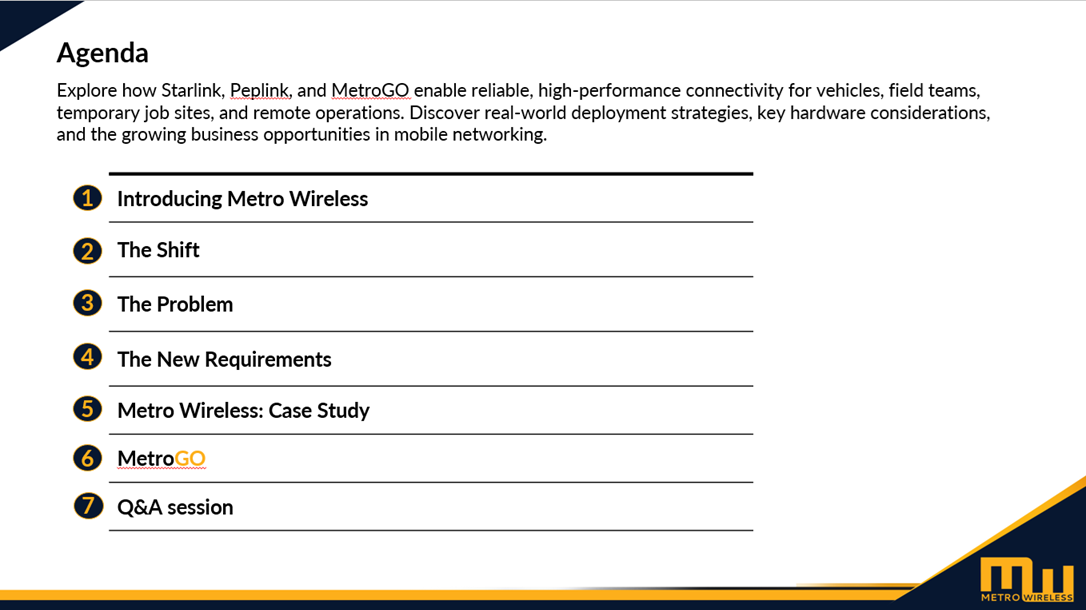
You can see the agenda as we have it here. Please note your microphones are muted. We'll get into a Q&A section at the end, and I'm looking forward to a lively discussion there. Feel free to send any and all of your questions while I'm chatting or while Tom's chatting, and then we'll answer those towards the end. We are recording this and will post it on our website and send it out to those of you attending today via email. So thank you all for coming.
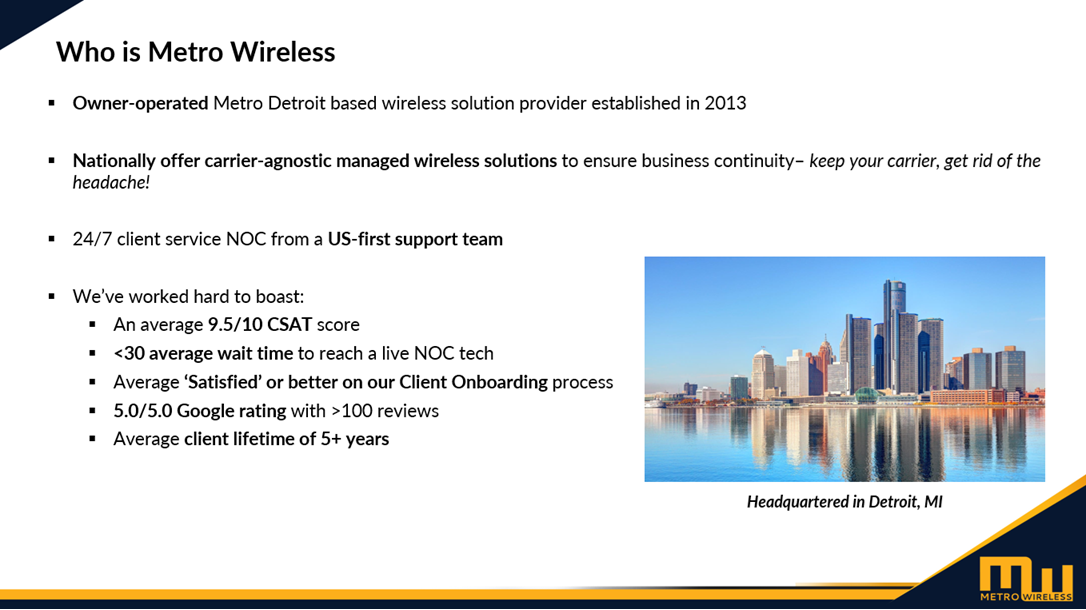
Paul: Tom, here we go. For those of you who are new to Metro Wireless: we began our wireless journey over a decade ago as a wireless ISP in the greater Detroit, Michigan area. That's still going on today, but we've grown up as a wireless engineering firm.
If I'm going to have you think about Metro Wireless, I'm going to say: all things wireless, except mobility. So we're not selling cell phones, cell phone plans, or tablets. If it's wireless outside of that, come to us. Tom and I will tell you quickly if it's not a fit, because we don't want to waste your time or ours — and we'll also jump in, roll our sleeves up, and make it happen for you.
There are three areas in which we excel and focus on:
1. Wireless Wide Area Network (WAN) — Think 5G cellular, think Starlink, and really our unique bonding capability where we can pull together multiple instances of a variety of wireless technologies and give your customers up to a gigabit per second of download speed — something that most of you have very rarely seen in the channel space.
2. Wireless Local Area Network (LAN) — That's DAS. It's weekly now, Tom — we're getting a new DAS / cell-signal-boosting project coming at us constantly. We compete very favorably against the big guys like Ericsson and Nokia. We are also heavily into Wi-Fi; we recently became an Aruba Certified Partner.
3. Private Cellular Networking (PCN) — For outdoor venues. You've probably heard us speak about that on previous webinars.
The third area, which is the topic of today, is wireless mobile or portable — think vehicles, think portable. "I want to take the internet with me wherever I go." That's who we are.
Two last things I want to add: we are entirely channel-centric. Our net-new customers come 100% from you, from the channel community. We are not out there prospecting. And, in this AI-driven world, we like to brag that our tech support is live engineers. Your customers will call us and, in far less than 30 seconds, get a live engineer on the line. That's very important to us.
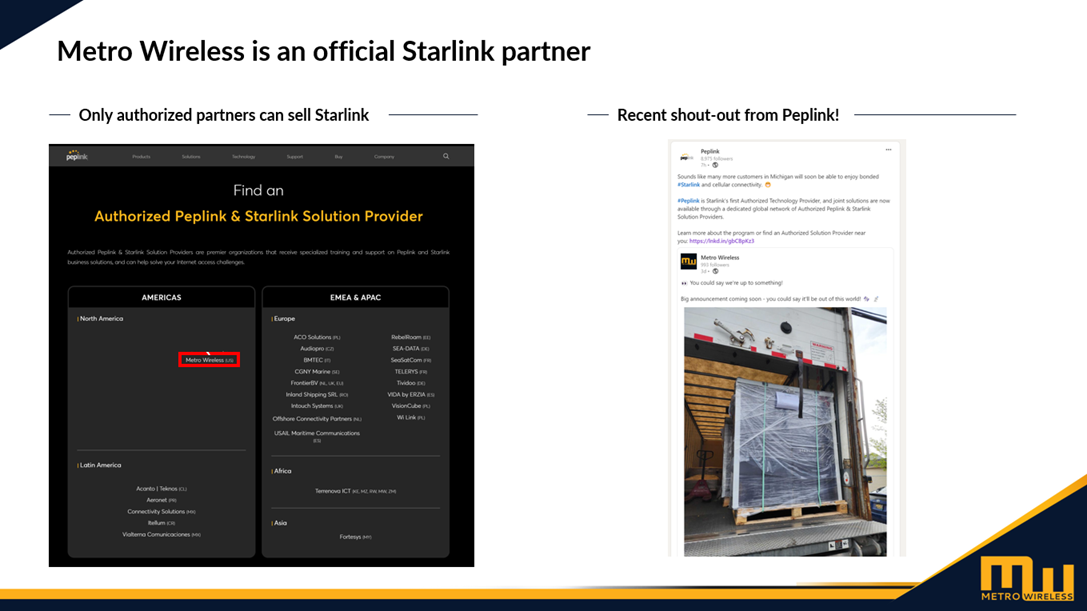
Paul: I mentioned Starlink a bit ago. We've been an authorized solution provider of Starlink for over two years. Some of you were on our last-quarter webinar where we highlighted the real capabilities — and the limitations — of Starlink. We've got nearly 800 instances installed. We know Starlink up and down, back and forward.
I do want to mention — about a month ago, we were on a webinar with Telarus, and they mentioned that one of their suppliers was selling Starlink solutions and had about 700 of those decommissioned and shut down by the "Starlink police," because that supplier was not a certified, authorized solution provider. There are posers out there. Be careful, ask the questions, get things in writing. Imagine if one of those shutdowns was your number-one customer, let alone a Fortune 500 — the egg on everybody's face would be unbearable. We're there. We're legit.
I'm going to hand it off to Tom now. He's going to get into the topic of the day: portable mobile internet. Here you go, Tom.
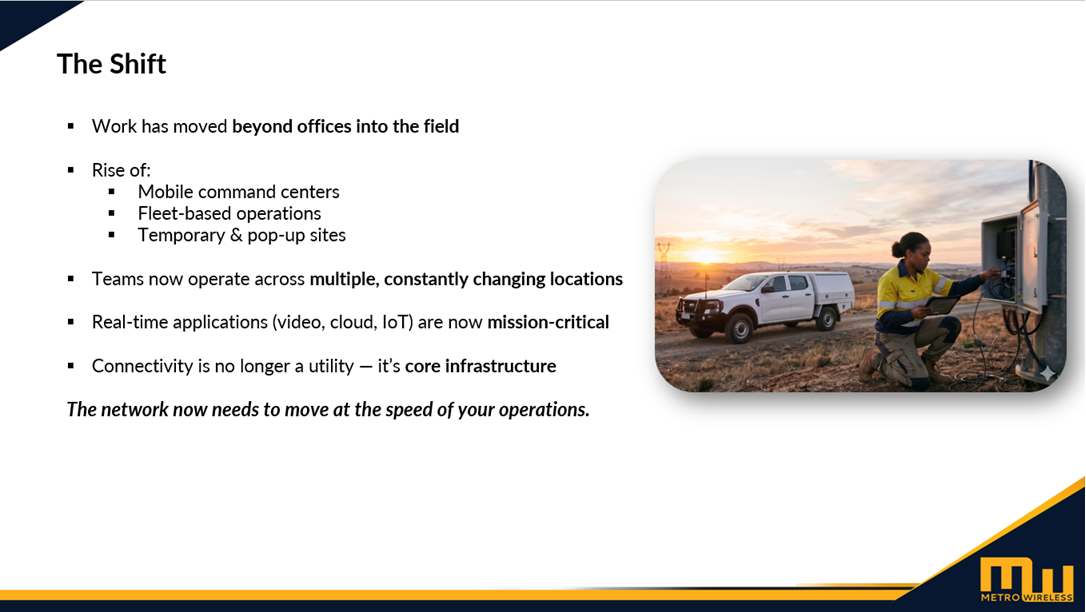
Tom: Great. Thanks, Paul. So — the shift. Here's what we're experiencing and seeing, and assuming you're seeing it too because you joined this webinar: the concept of driving around in a truck and noting things on a clipboard? That's done. People want the same workflows; they want to use the same ERP systems, etc. Everything needs to be IP-enabled. The fact that you're not in the office is no longer relevant.
We need to bring enterprise-grade communications to the mobile workforce. The total addressable market on this is enormous. Every field services truck, every mobile command center, every vehicle that has tens or hundreds of thousands of dollars invested in it — plus an expensive employee inside — needs enterprise-grade internet.
For years, it's been cellular networks, and that's a valid solution. Cellular networks are very reliable. A point I've been making recently: 100% of American businesses use the cellular networks every single day. It is the most relied-upon technology in America. And delivering Starlink, or AT&T, T-Mobile, or Verizon, as a wireless ISP across the country is a highly reliable service that the market has voted on — everybody uses it.
We're going to talk about mobile field operations today. Delivering enterprise-grade wireless to a mobile field services or mobile operations center — however you want to define it — is the topic of today's discussion. Next slide, please.
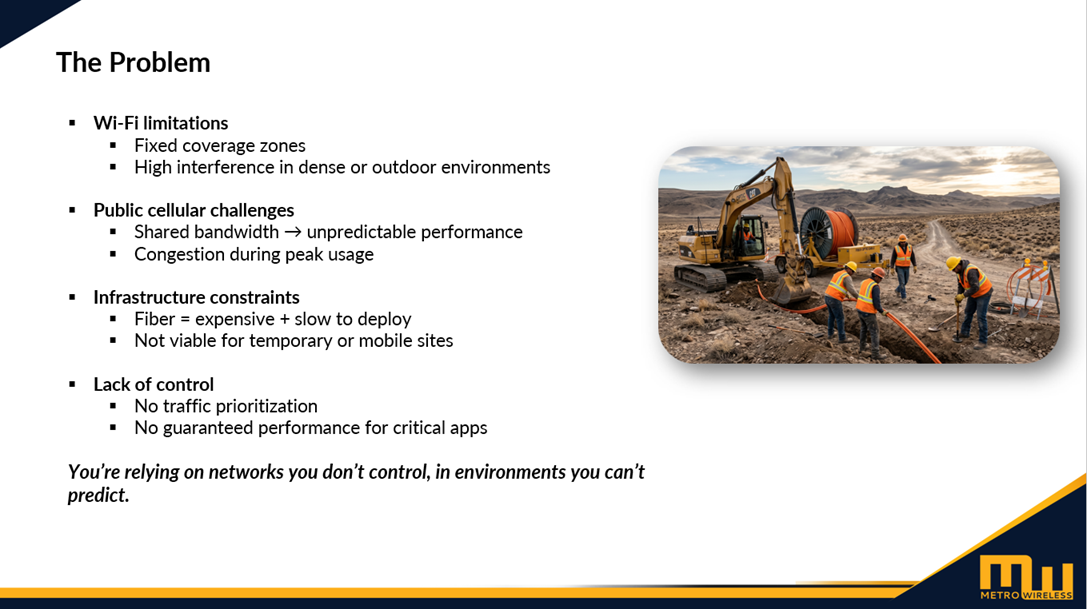
Tom: So what's the problem? Wi-Fi doesn't reach the field — pretty self-evident. If you look at the picture, they're in the middle of nowhere, and yet they need to log in.
Let's focus on Starlink, because Starlink offers something cellular networks do not: 100% coverage anywhere in the country. No excuses. The bottom of the Grand Canyon — sure — but none of your customers are at the bottom of the Grand Canyon. Setting aside very strange outcomes, Starlink will get you service wherever you need to go. If you can see the sky, you can get to Starlink.
This is how we're going to power these devices. It's a specialty service. Starlink has made some changes to their program to make it easier. They've stripped away some of the limitations from when Mobile Starlink was first introduced — it was more expensive than fixed-site. They've eliminated that gap. Mobile and fixed-site are now at the same cost on a consumption basis.
So how do we engineer a high-quality service that becomes like a light switch — it just works? That's the goal. Next slide.
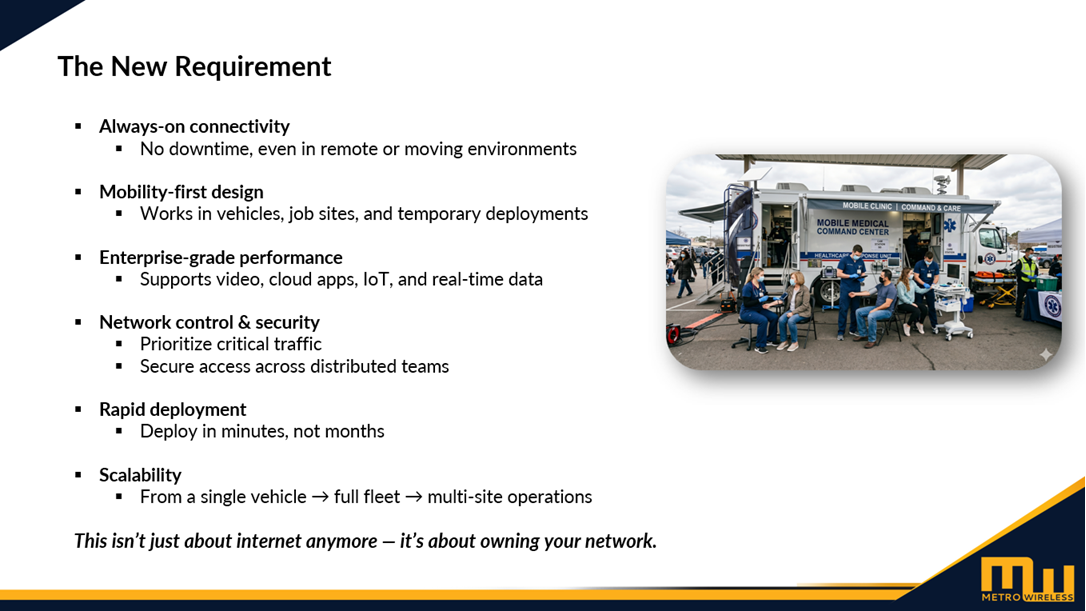
Tom: We need always-on connectivity. It needs to be rugged. We're moving — which means vibrating, getting rained on, etc. We're no longer in a comfy office at 71 degrees. We're going into odd places, dealing with vibrations, and vibrations wreck electronic equipment.
This isn't a hobby. You need not just ruggedized gear, but ruggedized mounts, and it needs to be installed professionally so that it works six months from now, twelve months from now, two years from now. I put a 4G router on a bulldozer moving coal in a 130-degree bunker four years ago. It lasted a month and a half — it rattled apart, because it was on a bulldozer. We put a ruggedized router out there instead, and it ran for six years. There is a real difference in grades of electronics. If you put something cheap in the field, it will break. That's a guarantee.
There are 20 different things you need to do right to make this a utility-like experience — you just flip the switch and it works. We know those 20 things, and frankly, we've gone through the learning curve. Benefit from our experience. If you do one thing out of the 20 wrong, it doesn't work, and you're in troubleshooting mode. That's why we advocate going with the pros for a seamless experience.
Network control and security is another critical point. Just because it's field services doesn't mean information security requirements drop — your CISO and CIO will not allow that. Everything we terminate to uses the same business-grade control plane and Peplink routers — widely accepted from an information security standpoint. We're not putting Netgear stuff in the field.
You can also get static IP on these solutions. At least 50% of companies still insist on static IP for their firewalls and security protocols. Starlink Direct does not offer static IP — I don't care what anyone tells you. They offer something called a "persistent IP" or "public IP" and imply it's the same thing. It's not. You can't ping it from the outside, and it will change as you move between ground stations in a mobile environment.
Check each of those 20 boxes and it works every day. Miss one, and you're in troubleshooting mode instead of selling the next project. And we all know in the channel that we need quiet customers so we can focus on the next deal. Next slide, please.
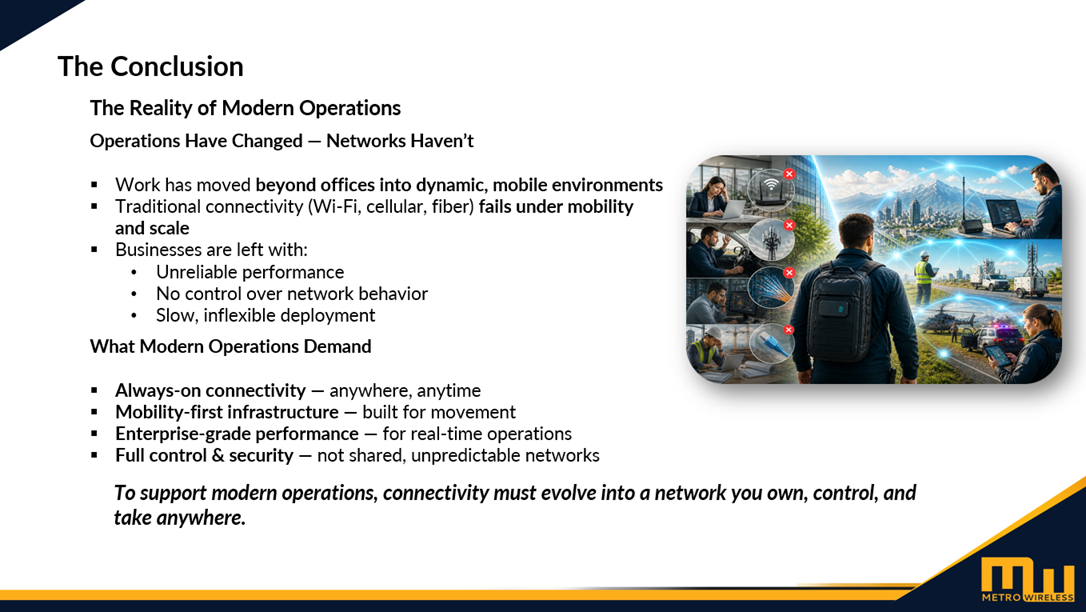
Tom: In summary — the TAM on this is big. Services keep moving out into the field. People don't come into the office. They're looking for efficiencies wherever they can find them, and they need to bring enterprise-grade, safe, secure wireless with them.
Starlink delivers service anywhere in the country. There are variations where we could use 5G — and layering in 5G in areas where coverage exists is very valid, since most people spend most of their time in covered areas. It's very difficult to get outside cell network range in this country — not impossible, but difficult.
If you're in oilfield services, you need Starlink. If you're a mobile medical command center in the suburbs, you might not. Bring us an opportunity and we'll help qualify it and come up with the right combination of networks for the best performance and cost.
Always-on connectivity. Enterprise-grade performance. Full control and security. That's the summary. Let's get into the details. Next slide.
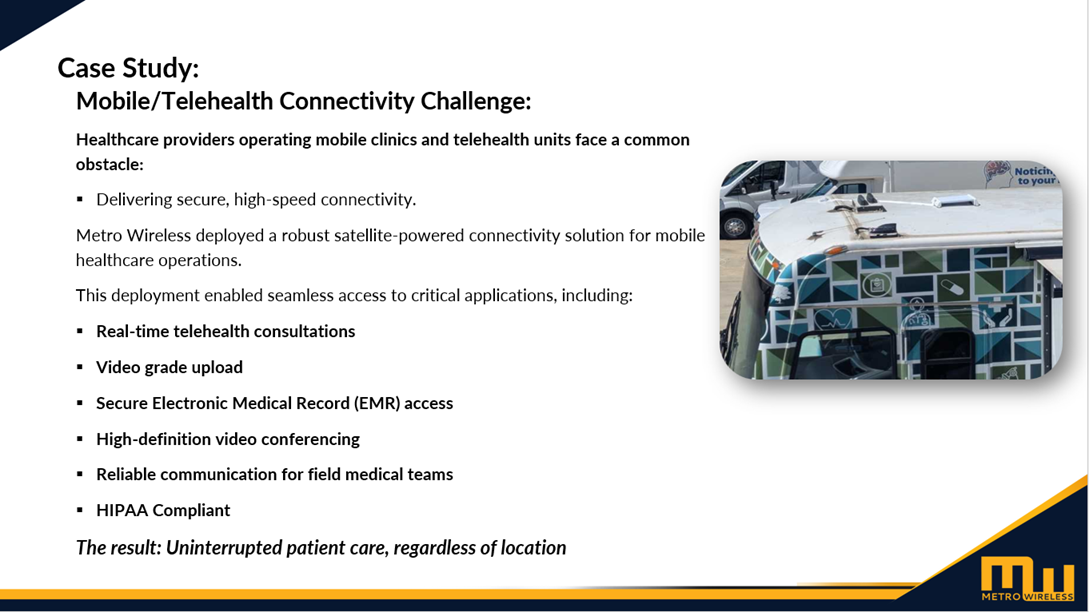
Tom: This is a case study for a mobile health clinic. There are thousands of mobile health centers out there — mobile mammogram, mobile dentistry, mobile community health centers. You are bringing a hospital-grade service into a truck. There's at least a million dollars in each of these vehicles, plus highly paid professionals billing insurance significant amounts. These are incredibly valuable assets and they need enterprise-grade connectivity.
This particular one required real-time telehealth consultations with video-grade upload. To support video, you need 15–20 Mbps minimum upload for a smooth Zoom or Teams experience, and it also has to be HIPAA compliant. EMR must be secure, video conferencing must run smoothly and work everywhere.
Paul, was this a single Starlink on top of the truck?
Paul: That is correct. And I believe it was the Enterprise dish, not the mini.
Tom: Correct. You can see in the picture that the Starlink dish is mounted on top, then a wire runs down — through a wall penetration rather than the roof, so we're not introducing water to a million dollars worth of medical equipment. They went from unreliable connectivity to a circuit that works everywhere they go.
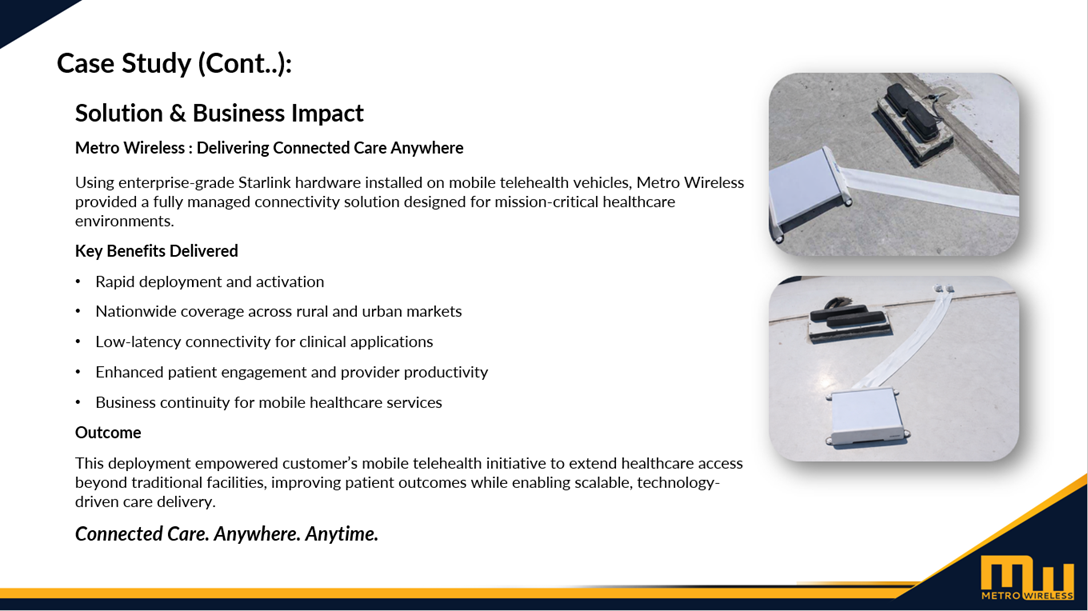
This is also very repeatable. People who run mobile health tend to have more than one vehicle — you usually see clusters of three, five, or ten. Once they find a solution, they keep deploying. So you're catching a wave on the mobile medical side. Anyone with exposure to mobile medical: they're looking for this solution.
Paul: And I can add — on this particular project, we installed on two different massive RVs: one was dental-only and one was medical. I didn't even know dental RVs existed until this project. And the mammogram use case is huge — they're everywhere. The calls and emails we're getting about this just this year alone — it's out there.
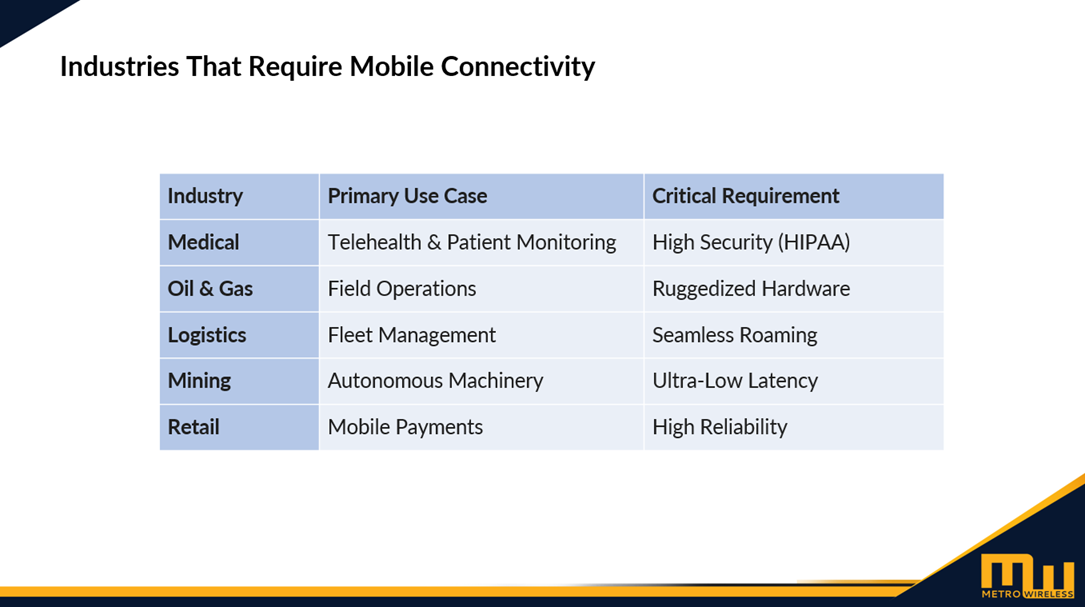
Tom: Looking at the TAM by industry — mobile medical is the number-one category. Any medical customer you have may not have a deployment today, but they speak this language. There's also specialty companies where that's all they do. Mobile MRI is probably the leading use case — hospitals outsource it. You see a semi or RV parked in a hospital parking lot constantly. How are they getting internet when they pull up? The hospital isn't letting them on their network. The CIO won't allow it. So they need to bring the internet with them.
Oil and gas is the number-one wireless business consumer in the country. If you have any exposure to oil and gas — or power more broadly, meaning wind, solar, electrical grid, pipeline distribution — the amount of money invested in maintaining those assets in the field is enormous. There are more than a million people working in field services for power alone. Metro Wireless's three biggest customers are power companies.
Solar is exploding. Wind is exploding. They put solar where land is cheap and sun is abundant; they put wind where land is cheap and wind is constant. Internet is always an afterthought — and the calls we get from people trying to get fast internet to their solar field or wind farm are weekly. It's ongoing.
Fleet management — the rolling stock, the truck, the employee, and the gear in the field: it's probably half a million dollars when you add it all up. Every field services company is lean and "just in time." If it breaks, they've got to fix it immediately, and they need to bring the internet with them. Every truck you see on the highway with a company name on the side probably needs good mobile internet.
Mining is a big industry in remote areas, and they also send trucks out into the field.
Food trucks — how many do you see? They all need fast internet. If you need to level up beyond your phone's hotspot, throw a Starlink on top and you're done. It's more professional.
If it's moving and it's a business, it probably needs mobile internet. The total addressable market is quite high. Next slide.
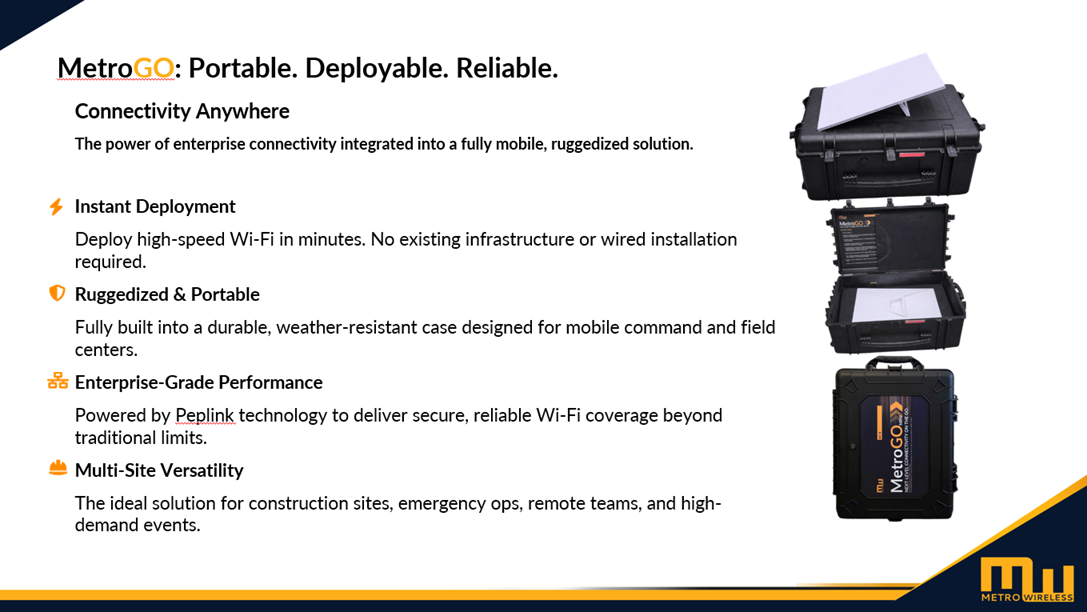
Tom: We've developed a kit. We have two options for mobile internet. What we've focused on so far is permanently installing connectivity on the asset. Now let's expand the zone a bit.
What if you want to put the internet in the back of a truck, take it to the site, take it out, set it up, have internet, then move it to a different truck? What if mounting it permanently isn't practical? There are a million reasons for this.
So we've developed MetroGo — portable, deployable, reliable. It's a weatherproof Pelican case, custom-built by our field services team. In the top-right of the picture: a Starlink dish on top of the kit. You take your kit out of the vehicle, open it up, take your Starlink dish out, pop it on, close up and set on top — done. Run a wire and you have internet.
You can also add a 12-foot telescoping pole and a Wi-Fi broadcaster, and now you're pushing Wi-Fi out a third to half a mile in every direction. You're creating job-site Wi-Fi with this. We've deployed this numerous times. I was getting Wi-Fi just about half a mile away walking through trees — I was pretty amazed.
That's Version 1. There's also a smaller version using the Starlink Mini, which just sits on top of the case without even opening it. Smaller form factor, lower cost. The downside: the Mini dish is not as fast — you sacrifice roughly half the download speed. But you could take it on an airplane as carry-on. It gets very portable.
When we say ruggedized: it's padded and weatherproof. Rain — no problem. It has external power ports and external WAN ports, all weatherproof. Plug your ethernet cable into a laptop or device without worrying about the weather. All built into the kit. There's also a Peplink router inside for the control plane, and it gives us the ability to add a 5G circuit and bond them together for dual performance.
Paul: And the cool factor: when people see this, it instantly makes sense. The sales cycle is short for end users who are looking for exactly this solution — they've had the problem for a while, and here's the answer.
We've got one of these in Australia right now — Paul Saldorn down there reached all the way from the other side of the world. We have an Australian power adapter in it, so they just plug in. That particular box is for airfields — they pull it out, open it up, put the dish on top, plug in, and now they've got a Kenbotong access point beaming Wi-Fi. Whether it's raining or dusty, at the end of the day they reverse the process, bring it inside, and repeat.
We're also adding extra fans for hot-weather environments like Arizona. These are custom-built — we don't stock a single SKU. We build them to what your customer needs. Tom and I always say: imagination and finances are the only limitations. Bring the ideas to us.
Think first responders fighting fires on hillsides — they often need internet with no other option. We can put battery packs in these too, backing them up for two to four hours.
Tom: I just quoted one yesterday for almost the same use case. They're going to ports and setting up to fix cars in large lots. Think of a recall on an alternator switch — a thousand cars show up in a parking lot and mechanics need to log repairs, scan barcodes, etc. How do you do that in the middle of a field? Pop up a kit, run it for three months, move on to the next job.
Paul: And don't let the United States be your border. We've got one in Australia, and another going from museum to museum in different countries. Long story — call me.
Paul: All right, folks — remember: for any opportunity, think wireless, think Metro Wireless. Email us at sales@metrowireless.com — it'll hit several of us so we can respond quickly. Reach out directly to Tom or Paul if you prefer.
Before we get into that, I got a text from a good friend of mine, Michelle, out of Wyoming. She said she's been working with someone who offers Starlink and is experiencing 6–8 week delays on getting dishes. I know the company she's referring to. I believe Starlink may represent 1% of their total business — which tells you they don't stock these things.
At Metro Wireless, wireless is 99% of our business. We stock Starlink dishes, cable kits, mounts, and modems. We're ready to ship same day or next day if needed — not six to eight weeks like companies that treat this as an afterthought.
So that was question number one, Tom.
Tom: Here's how we'll run the Q&A: we'll read each question out loud — so it's recorded and everyone can hear it — answer it, then move to the chat for anything else. Please go ahead.
Question 1 (Ernie): What about mobile while the vehicle is moving, traveling to different sites?
Tom: The answer is yes — this circuit is live while traveling. Starlink has gotten very good at handoffs. If you can see the sky, you're getting the same download performance as at a stationary site. Two years ago I couldn't have said that with confidence. I now say it with confidence. That opens up a whole new world: traveling buses, traveling roadshows, etc. People are charting and working while moving. Internet while moving? Absolutely yes.
Question 2: Is this a resold option only, or a white-label partnership?
Tom: This is a channel-only sale, with commissions paid. I want to be emphatic about this because of Paul's story earlier. Someone might think: "Maybe I could just resell this on the side." With Starlink, they absolutely forbid it. A major TSD told us that a recognizable channel name had 700 customers immediately turned off by Starlink when it was discovered they were selling on their own paper. If you want to be in this business, you have to be an authorized Starlink provider — and Elon is not playing around. If you get a Starlink quote from someone, ask: "Are you an authorized Starlink provider? Prove it." Every authorized provider is on a published list. Starlink makes a big fuss about this.
Tom: Jumping to the chat. Hopefully we're not all just talking about basketball over here.
Paul: Hey, Tom — I've got one. This is from Joe in Nashville.
Question 3 (Joe): Can you arrange for installation of the solution?
Paul: Can we handle installation on, say, a telehealth van or mobile vehicle?
Tom: Yes, we handle that ourselves. A subset of installers are certified for automotive/vehicle work. Most mobile command vehicles have 110V AC power outlets — occasionally we're direct-wiring to the vehicle's power system, which requires a skilled technician. You also need a penetration into the structure, and the mount must be secure for travel. For all those reasons, self-install is not ideal. If they're experienced mechanics they might manage it, and we could walk them through — but we'd prefer to just take care of it. It's a specialty install, and you want it done right so you never have to worry about it again.
Tom: (from chat) A comment: "Brunson's not 6'3" — he's 6'1"." Agreed. I thought I heard 6'3" on the broadcast last night and thought, "He doesn't seem that tall." Anyway, probably not that important.
Question 4 (Jason): Do you have a partner program where I can sell the service and do quotes?
Tom: Absolutely. Contact your favorite TSD. Examples: Telarus, AppDirect, GTS, Jenne, Utel — we'll work in the traditional channel model.
Paul: And Intellisys —
Tom: And Intellisys. The new kid — that's right. We closed the acquisition of a company called Volley two days ago, and with that came an Intellisys relationship.
Question 5 (Matt): How is the service commissioned — all MRR?
Tom: That's not quite right, Matt. The NRC on the MetroGo side is also commissionable. We pay 10 points on NRC and 20 points on MRR of the Starlink service, after subtracting out the Starlink data plan cost — like everyone else does in the channel. Contact your channel manager for details. We pay market rates; there's no shortchanging on commissions.
Paul: And depending on the project — let's assume Matt is a TA based on his questions — even if an NRC is amortized over the contract term, those are generally still paid out as a one-time commission. Bring it to us and we'll make it work.
Question 6: What type of contract terms are applied — month-to-month or yearly?
Tom: Month-to-month is pretty rare for a mobile installation of any kind. If they need it now, they're going to need it next month and the month after. I don't see MetroGo services going out the door month-to-month — the cost would skyrocket anyway for just a month's use. One-year, two-year, three-year terms are the norm, and the most advantageous pricing is definitely on a three-year term.
Question 7 (Federico): How does it compare to DIA? Are Starlink speeds similar?
Tom: No — with one-gig fiber connections at $99 (or whatever the advertised rate is), Starlink doesn't match DIA. Sending light over a tube of glass is always the most efficient way to send data — that will always be true because of physics. Where Starlink fits is where fiber does not. I've been saying this as a wireless professional for 13 years: if you can get fiber, get fiber. It's cheaper and faster.
Having said that, once you have fiber and build your business on it, you have a new problem: fiber gets cut. There's no debate on this. If your fiber is cut, what's the impact? Generally, 70% of compute power is now in the cloud — if that disappears, what happens? That's where Starlink becomes relevant again. Starlink sits alongside DIA; it does not replace DIA. Unless you're moving, or you can't get fiber, in which case we're looking to wireless to deliver a DIA-like experience.
Paul: And just to clarify — today we're talking about mobile, portable internet. Fiber is not available on a moving telehealth vehicle. But for an office environment, everything Tom said comparing wireless to fiber is 100% accurate.
Question 8: Are your mobile connections carrier-agnostic, and what data speeds are usually provided via cellular failover?
Tom: Yes, carrier-agnostic. I won't dive into eSIM versus native SIM today, but our strong opinion: find the nearest cell tower, see its capabilities, and put a native (branded) SIM there. You're inside the walled garden of the carrier. We are not a big eSIM shop — it's the lowest quality SIM available, the equivalent of Cricket Wireless or Mint Mobile. Your enterprise customers don't run their cell phone plans through Mint Mobile, so why would they run their business on the same type of network? There are three networks in this country — AT&T, T-Mobile, Verizon — and if you don't have service directly with one of those, you're using a reseller.
For cellular failover speeds: in a properly engineered circuit, you should see 150 Mbps down off a 5G tower with the best carrier and a rooftop antenna — because the 5G frequencies don't penetrate buildings as well. Pick up the signal outside and it runs faster.
If you want to go faster: you can't get to a gig on a single connection, but we're in the business of bonding multiple connections. To protect a 1-gig fiber circuit, is 150 Mbps 5G adequate? Honestly, no — if they had 150 Mbps, they'd have a 150 Mbps circuit. They have a 1-gig circuit for a reason. We'd want at least 300–500 Mbps to keep the business operating comparably. If you need fast wireless, come to us — this is our daily bread.
Question 9 (Matt): Can you structure professional install via an OpEx model?
Tom: We'll talk about it, Matt. We're creative. We don't want NRC costs to get in the way of a deal. Having said that, we are a terrible bank — if we finance something, it'll cost a lot more over 36 months than paying upfront. But we don't want install costs to be an obstacle.
Question 10 (Josh): Any hardware differences between the consumer version versus the commercial version of the Starlink dish?
Tom: Yes, and let me give you the full picture. Starlink has consumer dishes and business dishes — performance-wise, they're similar. You need a business dish for a business address. If you put a consumer dish on a business address, Starlink will find out and shut it off. Don't play that game.
Then there's the HP (High Performance) dish — a definite quality step up:
Paul: A friend texted me — outside the Q&A format — and asked: Is this HIPAA compliant?
Tom: Yes, absolutely. Peplink has been HIPAA compliant for seven years. If you're not HIPAA compliant in mobile medical, you're dead in the water.
Paul: Can we get static IP on these?
Tom: Yes, and you can get up to a /28 block if needed. We're an ISP in Detroit — not just an MSP. We have our own ASN for static IP.
Question 11 (Carla, Florida): Can you only use Starlink, or can you use 5G for areas with good coverage?
Tom: Yes to everything. Can we use 5G for the solution? I'd love to. If an asset spends all its time in 5G coverage areas, 5G is actually more economical. When we qualify solutions, we always look for the best one. Most of the country is well-covered by 5G. Put a small antenna on the roof to capture the 5G signal, and away you go. The full matrix: if you're going to get outside cell network range, you must have Starlink. If you're staying in 5G coverage 100% of the time, a 5G-only solution could work. Bring it to us, let's scope it and make a proper recommendation.
Can you fail over from Starlink to 5G and back? Yes. Can you bond them together so you're connected to both simultaneously? Yes. We've got a solution for any vehicle that needs internet anywhere in the country.
Question 12 (Federico): FedRAMP / CMMC approved?
Tom: Federico, I have to be honest — I don't know specifically what that means in this context. I believe it's related to government contracting. Send it to me directly and we'll have that conversation.
Tom: I think we crushed it. We got all the information we wanted to get out there.
Paul: If it moves and needs internet — we've got a solution. And if it doesn't move and needs internet, we've got a solution for that too.
Tom: There you go.
Paul: Thanks everybody for your time. Appreciate all the Q&A and interaction. Be looking forward to this being emailed out to you and posted on our website.
Tom: Thanks, everyone. See you next quarter.
End of transcript


