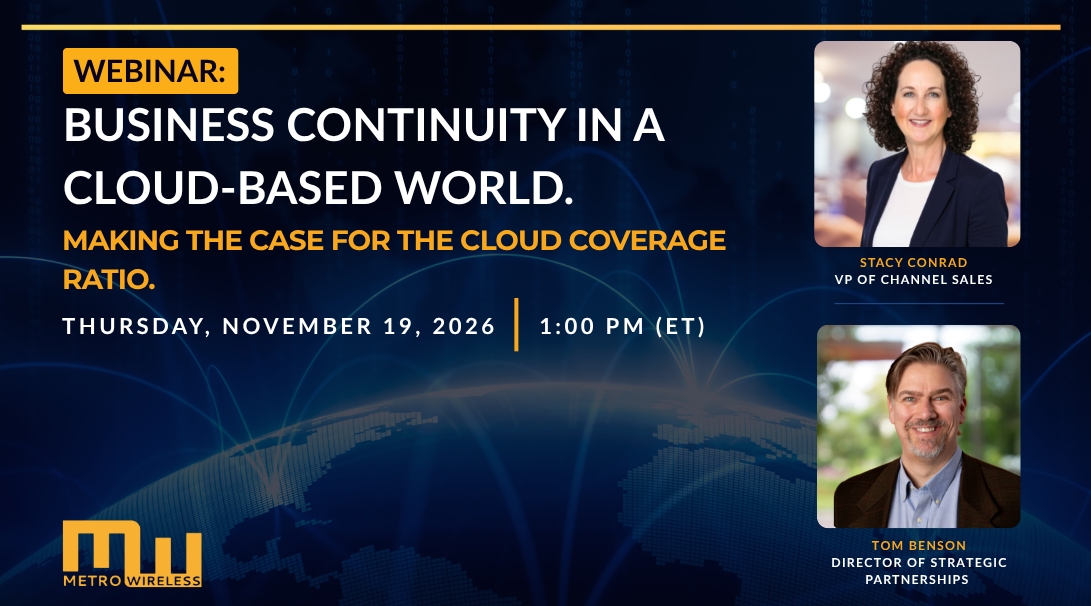
Most continuity plans protect the data. Few protect the connection to it. We're putting a number on that!
Quick question: if your customer's primary circuit failed right now, how much of their business would keep running?
Ten years ago, an internet outage meant slow email. Today it means no phones, no point of sale, no CRM, and no access to the files and AI tools the team uses every hour. The cloud made business more flexible, but it also made the connection the one thing everything else depends on.
Most continuity plans haven't caught up. Data gets backed up offsite. Applications get redundant hosting. The connection gets a backup line, the box gets checked, and everyone moves on. Nobody asks how much backup, because there's no standard for it.
Then the fiber goes down. Not at 3 a.m., but at peak, when every cloud app, VoIP line and AI tool is running at once. Your customer drops from 100 miles an hour to 10, and the backup they paid for turns out to be a slowdown, not a safety net.
And a fiber break doesn't take down one thing. It takes down everything on the other side of the connection:
For most businesses, that isn't an IT problem. It's the whole operation standing still.
Having backup isn't the question anymore. Having enough is.
Three answers every partner should have, and most don't.
The Problem. Why "Do you have backup?" is the wrong question in a cloud-based world, and why the backup many customers are paying for may deliver far less than they think, right when they need it most.
The Number. The one benchmark we believe belongs in every business continuity conversation. What the Cloud Coverage Ratio is, where the line should be drawn, and the two-minute math that tells you whether a customer is actually covered.
The Fix. Why the most common failover options fall short at peak, and what it really takes to close the gap.
Plus: the three questions to ask every customer that turn a backup checkbox into a real conversation.
Everyone sells backup. We'll show you how to keep the business running.
Stacy Conrad, VP of Channel Sales, Metro Wireless. With more than 20 years in the industry, Stacy has spent her career helping partners turn technology into conversations their customers care about. She hosts the session and keeps it focused on what partners need most: something concrete to take back to their customers.
Tom Benson, Director of Strategic Partnerships, Metro Wireless. Two decades in wireless and connectivity, from the T1/DS3 era to bonded 5G. Tom developed the Cloud Coverage Ratio to answer the question every customer eventually asks: how much backup is enough?


