November 20, 2026
Nov 19, 2026
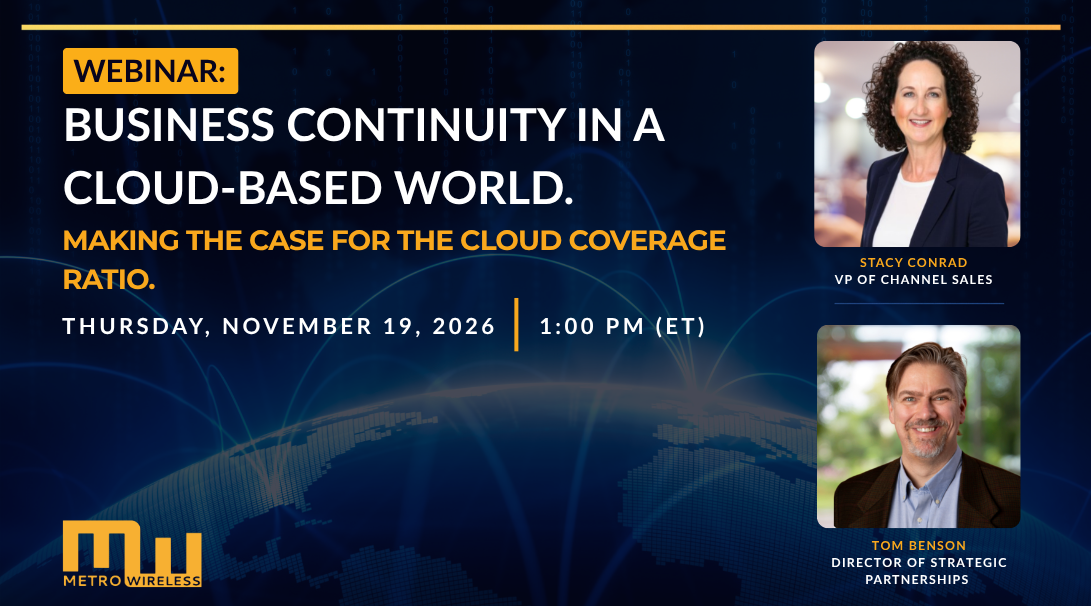
Metro Wireless partner webinar, "Business Continuity in a Cloud-Based World: Making the Case for the Cloud Coverage Ratio," recorded Thursday, November 19, 2026 at 1:00 PM ET. Runtime about 50 minutes. Timestamps match the cleaned recording.
[03:05] Stacy Conrad: It is. And for those of you who are just joining, this is Stacy Conrad and Tom Benson. We're just giving it probably one more minute to give everyone a chance to come in, get settled, grab your cup of coffee or tea, or I guess it could be an adult beverage. It's a little early probably for most of us, but we're excited. We're going to start in just a minute. We've got a great webinar for everybody today.
[03:29] Tom Benson: Yeah, definitely a little early for the adult beverage for most. Five o'clock somewhere.
[03:36] Stacy Conrad: But you know what, I think we will officially kick this off. So good afternoon, good morning, everybody. If we have not met yet, this is my first official webinar at Metro Wireless. My name is Stacy Conrad. I am the new VP of Channel Sales. Very excited as we bring you another great topic today: Business Continuity in a Cloud-Based World, Making the Case for the Cloud Coverage Ratio.
I have with me Tom Benson, one of my Directors of Strategic Partnerships. If you've met Tom or know Tom, or seen him on some of our webinars, you know he's a great wealth of knowledge. So let's talk about getting started today. You want to kick it forward, Eb?
[04:28] Stacy Conrad: Wonderful. Just the basic housekeeping, of course, before we start. Your microphones are muted just because of the volume of people on the call. If you do have any difficulties, you can send a note in the chat, or you can email Eb. Please put your questions in the Q&A, and we will share them at the end of the presentation. We'll have time to address them.
This webinar is being recorded, so no need to take any notes. We will post it on our website, and we'll send it out to you via email, so we'll make sure you have the details. And if someone on your team missed it today, you'll have everything you need to share it out.
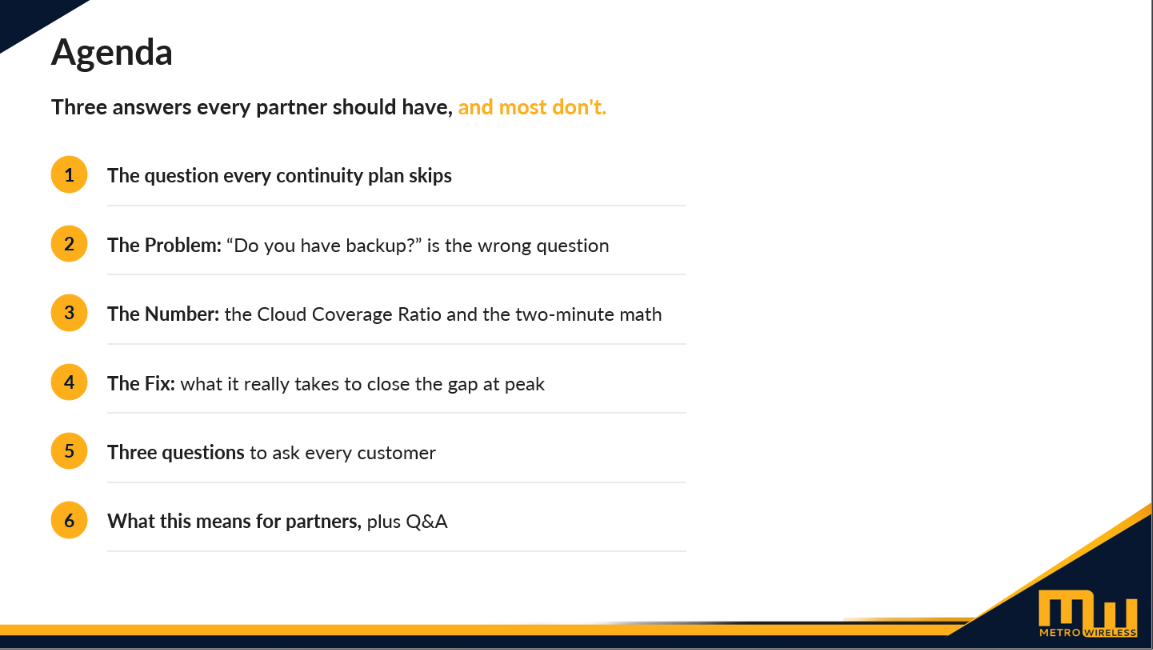
[05:07] Stacy Conrad: All right, what are we going to talk about officially today? We're really going to focus on the answers every partner should have, and a lot of you don't. We really want to talk about what continuity plans might be skipping over. That whole question, "Do you have backup?", is a little outdated, and what's really the right question?
Then the Cloud Coverage Ratio and the two-minute math. Tom's going to have a great section talking about how to really figure out what your business needs, not only at peak time, but more importantly, if there is an outage or there is some downtime. We're going to leave you with three questions that you can ask every customer to open up a really simple conversation. And then how this benefits you. So that's really the landscape of what we're going to do today.
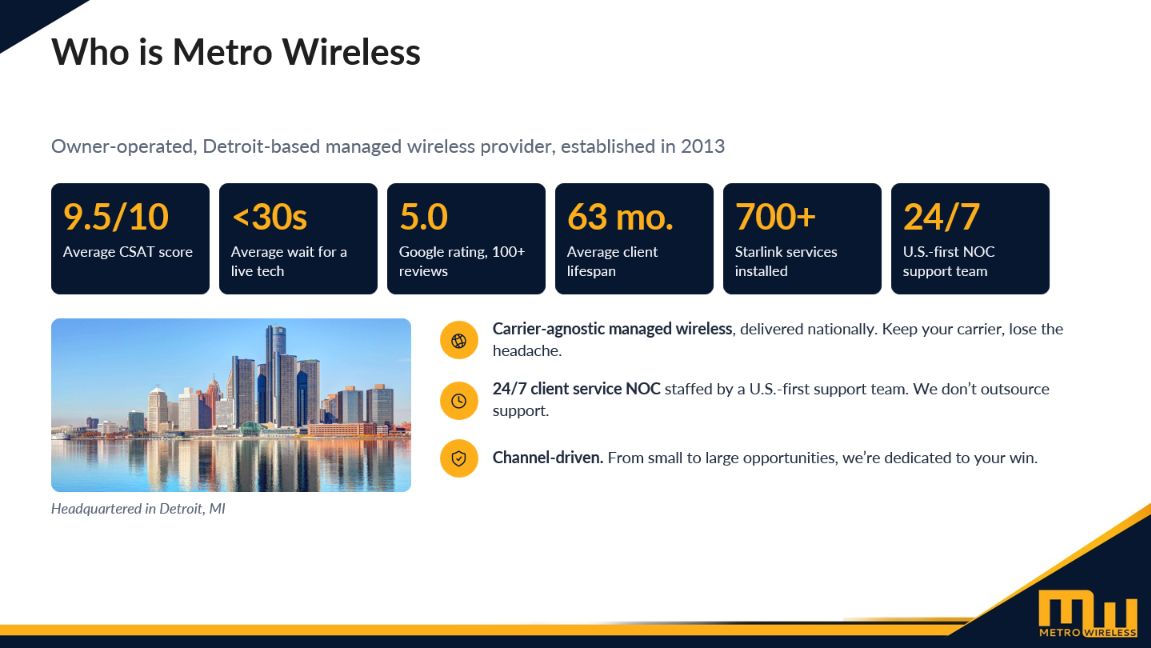
[05:58] Stacy Conrad: Always the one minute, in case you're new to Metro Wireless or you haven't been on one of our calls in a little while. As a reminder, we're fully owned and operated. We're a Detroit-based wireless service provider. We've been in business for over 13 years.
Lots of great taglines here, but the things I'll highlight the most: we still answer our phones with a live tech in under 30 seconds. So with all the advantages of AI, support still means human touch. We've also deployed more than 700 Starlinks, so there's always a little bit of Starlink in every conversation we do. If you've not talked to us about Starlink, make sure you do. And of course, we have a 24/7 U.S.-first NOC support team. Fully channel-driven, and excited to be doing more business with all of you.
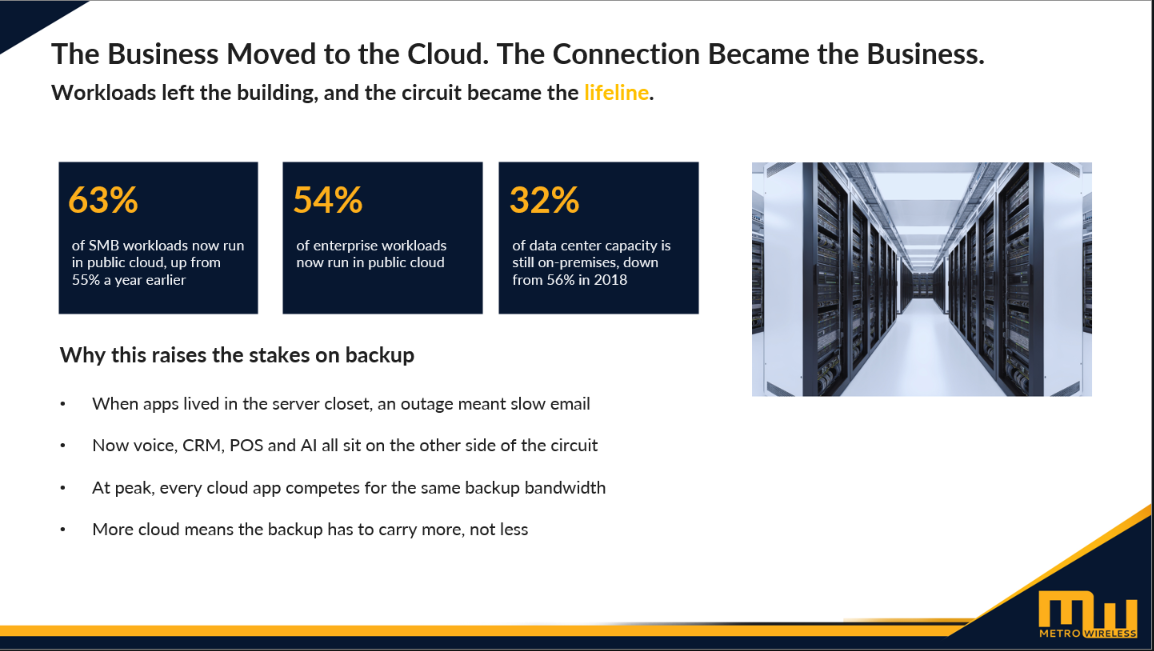
[06:51] Stacy Conrad: All right, this is where we're going to get into some of the meat and potatoes. Tom, you and I were talking about this as we worked on this deck, and it's crazy how things have changed. We try not to date ourselves, but when Tom and I were in kindergarten on the playground and we were talking about business moving to the cloud, we were talking about the sky and the rain. There was no cloud. Things have really changed, not just way back when, but even in the last three to five years. So let's talk, Tom, a little bit about why this matters and how this backup conversation has changed.
[07:28] Tom Benson: Yeah, what we're finding, and what everybody's noticing, but it is kind of like the frog boiling in the pot, is the cloud is the business. Or more accurately, everything is the cloud to some extent. Your fiber circuit is your business. It's not an ancillary thing that you buy. It is the business, because all your business is connected via the fiber line.
We moved everything to the cloud, and massive gains have come from that: massive efficiencies and ROIs, and all of you have been involved in dozens of projects for this. What may be glossed over is that the risk of losing that connection hasn't changed. We're going to talk more about that, but for right now, the main concept is: let's make the argument that your fiber connection is your business. That's an extreme example, but it's illustrative of everything we're talking about.
[08:29] Stacy Conrad: I agree.
[08:32] Tom Benson: Yeah. So let's get into it.
[08:35] Stacy Conrad: Right?
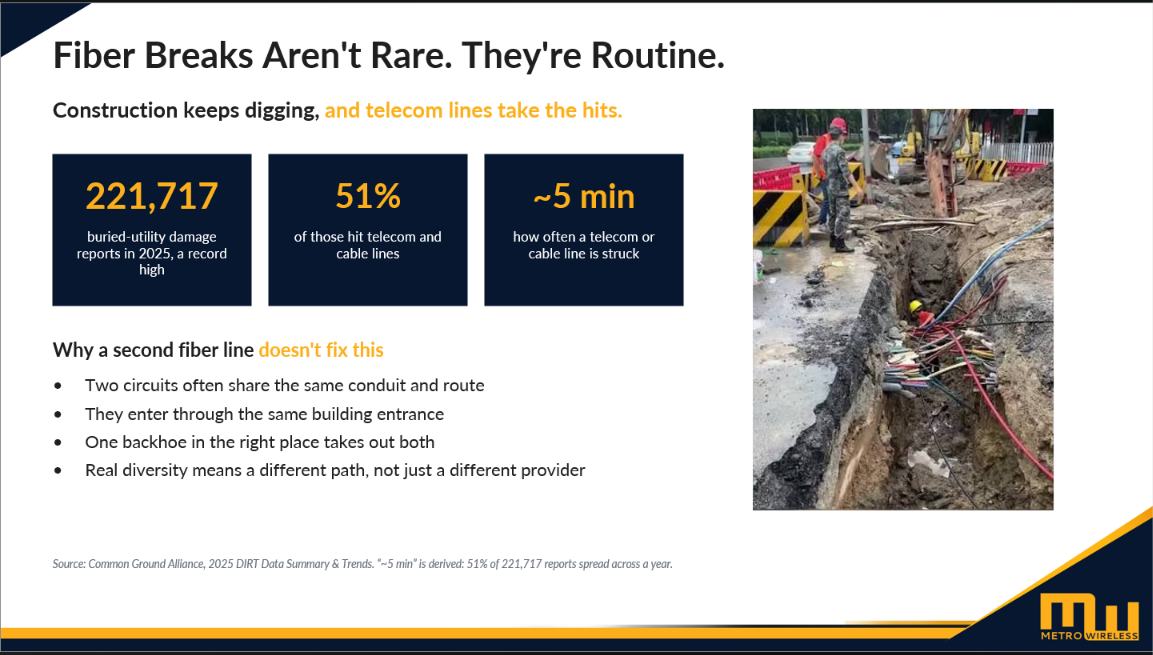
[08:36] Tom Benson: Let's go to the next slide, Eb. Yeah, here we go. Let's talk about that fiber. So what could stop it? If your fiber connection is your business, and we're making that argument, then what could happen to your fiber circuit? Well, if anyone tells you that nothing happens to fiber circuits, they're naive. Fiber circuits get cut all the time.
At my last company, I looked it up once, just for fun: how many different organizations are authorized to dig a hole in an urban area or a rural area? It was something like 35 or 50. The water department, the sewer department, the DNR, et cetera. They can all dig a hole. Anybody can dig a hole.
And this amuses me. Go by a construction site and see what they use to mark where the fiber is: here's where you dig and here's where you don't dig. Is it GPS? Is it geofenced? Is it some sort of elaborate thing? No. It's a little pink flag they stick in the ground.
[09:28] Tom Benson: The little pink flag they stick in the ground is protecting your entire business from a guy operating a backhoe who, to be candid, gives two shits about your business. He's there to dig a hole and he's going to dig his hole. That's just the way it is, and it's never going to change. People will dig holes and they will hit fiber.
So we can solve the problem or we can experience the problem, and we're here to advocate for solving the problem, because the impact is now much higher than it used to be. So that's sort of our opening statement. Next slide.
[10:05] Stacy Conrad: I agree, I agree. And the stats, we're letting everyone read them, but 221,000 last year is quite a bit. Go on.
[10:15] Tom Benson: And those are just the reported ones.
[10:18] Stacy Conrad: Yeah, Eb, you can flip.
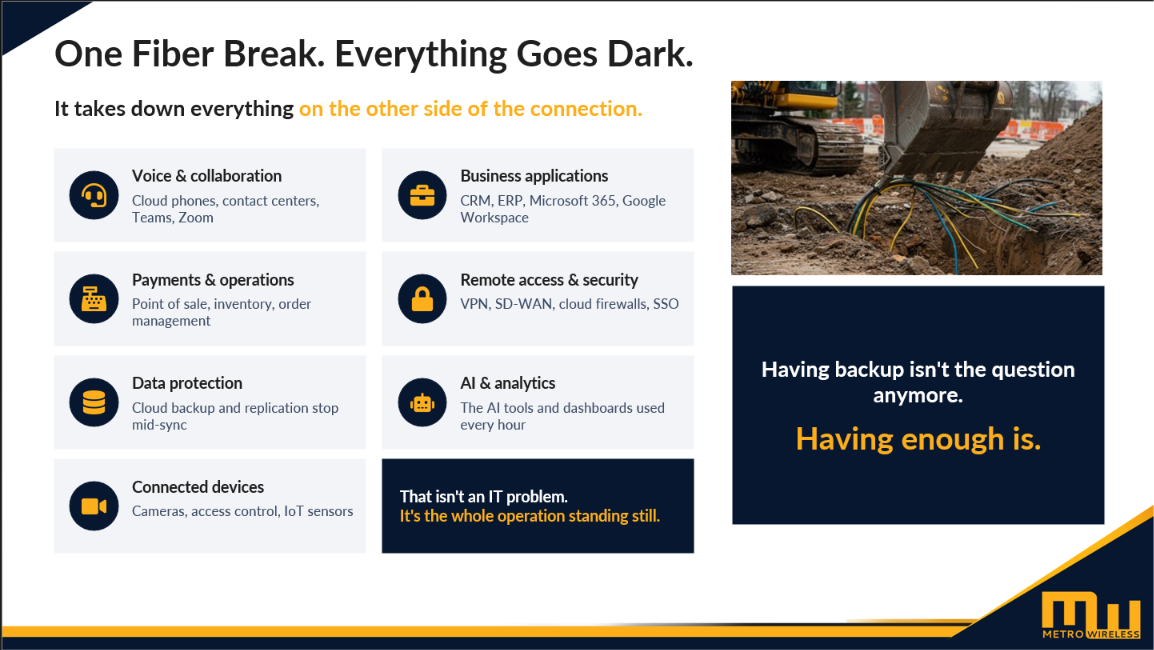
[10:19] Tom Benson: That also doesn't include in-building construction problems. Somebody is remodeling the third floor and they cut the wires going up to the seventh floor. That also counts. That doesn't count water main breaks. That also counts. Et cetera.
So what happens when it goes down? You've all been a part of this. Your analytics, your ERP, your financials, your voicemail. Sure, your phones work. But if companies could run on their phones, they would run on their phones. They have fiber for a reason.
Our larger take on this is: if a company loses its internet connection and it's not a problem for them, then they're not a great prospect for us, and they're not a great prospect for you. The channel runs on marketing to multi-site companies who have mission-critical needs and not enough IT staff to administer it.
So what we're doing is mapping our services to your larger initiatives: your IoT initiative, your cloud initiative and your AI initiative. They're all running on that fiber circuit, and they assume 100% uptime, but you don't have 100% uptime. What we're advocating for is: include us in your larger initiatives to ensure that all the gains you're recommending for your client are realized 100% of the time, while eliminating the inherent risk of basically making the fiber circuit the business. And so how do we do that? Next slide, please.
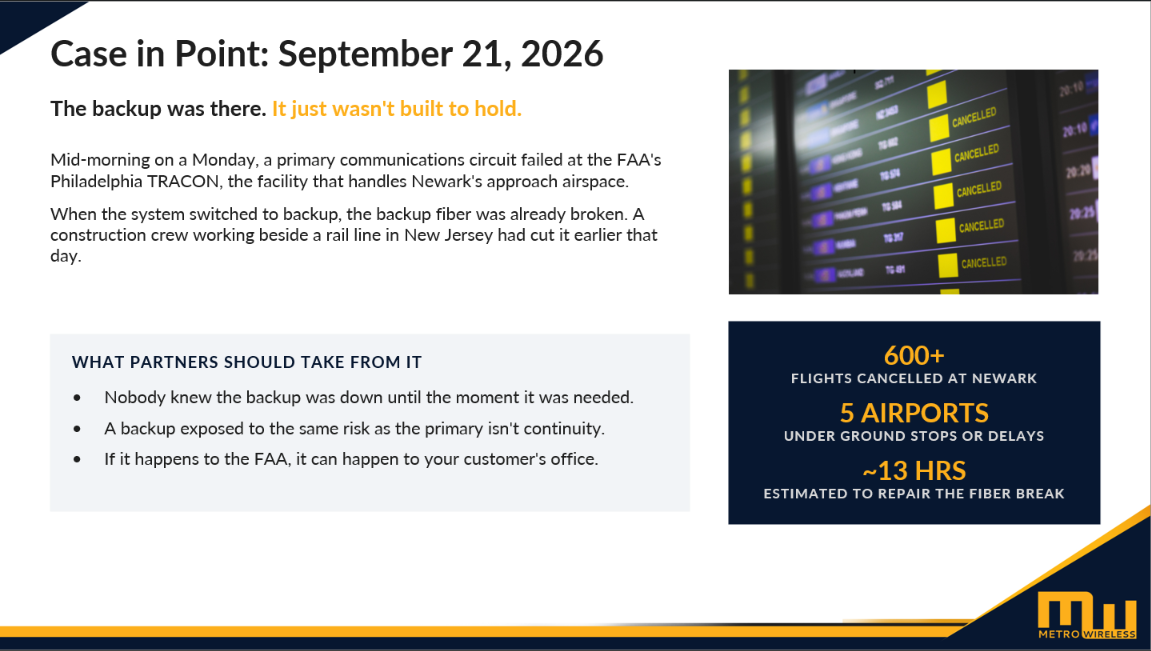
[11:52] Tom Benson: So as an example, it was all over the news: the Newark airport just went down. This is the latest in a string. I'm old enough to remember Northwest Airlines had the exact same problem, but that was in 2001. So 25 years later, a dual fiber circuit feed to a critical piece of infrastructure failed because both fiber circuits got affected. One got cut and one was previously cut or wasn't up and running, I don't remember.
But the point is, if you looked at this on design, you would say that the Newark airport has dual fiber feeds and they're fine. Wrong. And nobody gets to go back in time and say, "Well, it looked good on paper." It doesn't work that way.
The best example I can think of is a law firm. You bill by the hour. So if you're going to get on a Zoom call, you're going to bill $700 for that Zoom call. You miss the Zoom call, you don't get to bill that hour, and you will never get it back. Now, if a store goes down and it doesn't sell a candy bar, maybe it sells two candy bars the next hour. Now we can start to split hairs. But generally speaking, money gone is money that never comes back.
So if we say you make $10,000 an hour in raw revenue, or $20,000 an hour, or $50,000 an hour at your facility, and you disappear for two hours, that's $100,000 of revenue. Do you get it back? Do you get 100% of it back? Do you get half of it back? I don't know, but that's the math we're starting to get into here: what's the value of all the things that are running on that one vulnerable fiber circuit? Okay, next slide, please.
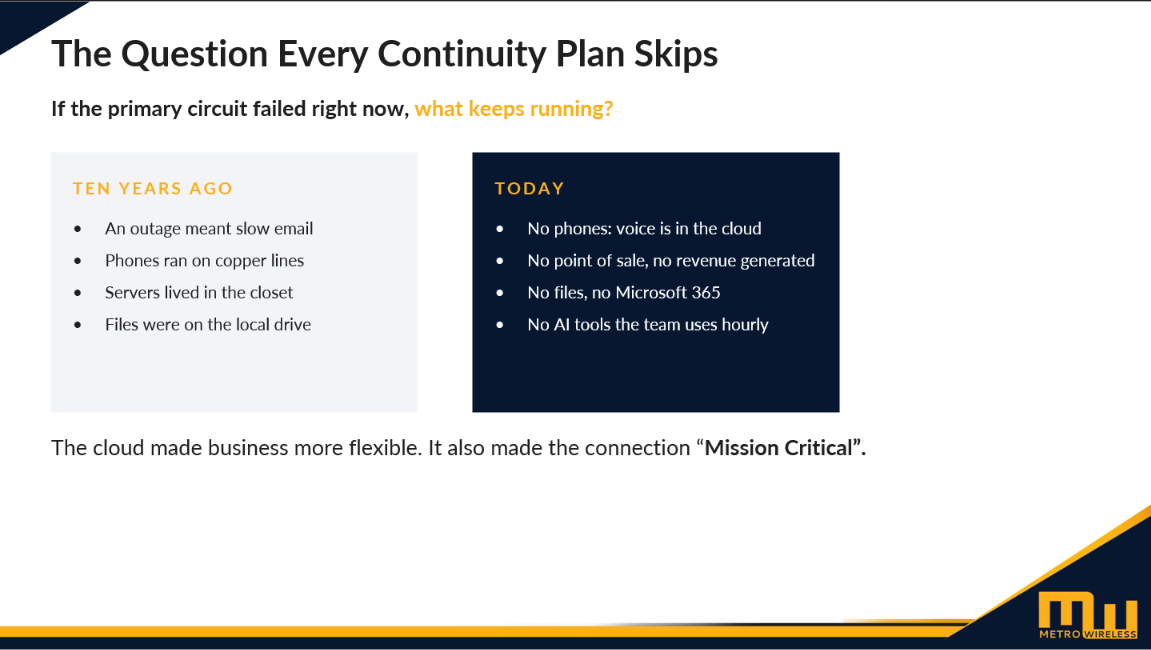
[13:35] Tom Benson: So, the continuity plan. Do we have a business continuity plan? We're starting to use the language of continuity, not failover. What does failover mean? I don't think it's a robust enough word, whereas continuity means what it means.
Dumb analogy, but you can hook a horse trailer up to a four-cylinder, but you can't take it anywhere. Technically, you are trying to pull it, right? So extending that dumb analogy: if you fail over to a 5 meg circuit or a DSL circuit, your business doesn't run. Everybody knows that.
The larger point, then, is if you fail over to a 4G circuit you installed in 2020, is that the same as DSL? And what applications are you willing to turn off because you don't have enough bandwidth? I would venture to say that if you asked a CIO what applications they're willing to turn off for two hours, their answer is none. "I have all these applications for a reason. They're here to do business." The better question is, how do you make sure none of my applications turn off? That's what we're here to talk about. Okay, next slide, please.
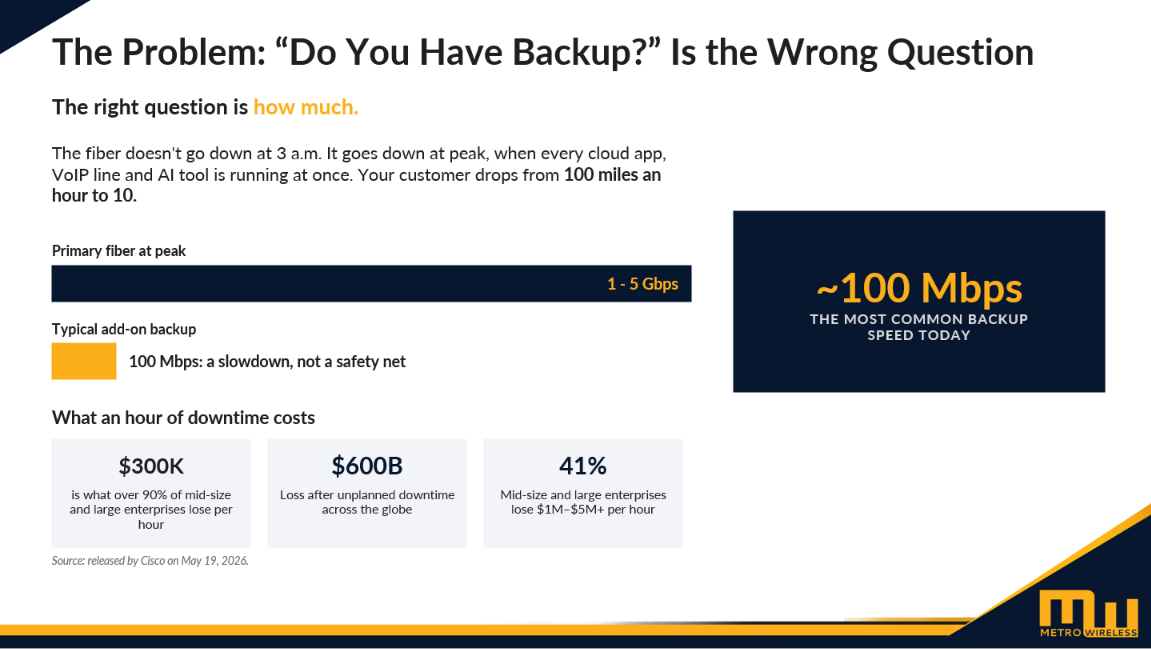
[14:49] Tom Benson: "Do you have backup?" is the wrong question. So let's get into the math. Right now we're just talking about a lot of subjective opinion, so let's actually get it down to the math. One of the things we'll assume is that when the fiber goes down, Murphy's law dictates it will go down at the worst possible time.
[15:10] Stacy Conrad: Yeah, no one has an outage in the middle of the night. Of course not. They have it at peak time.
[15:15] Tom Benson: Of course, so it will always be a disaster. Said another way, this is called contingency planning, and every business and every military organization talks about contingency planning. A guy I used to work for said, "Look, if you can eliminate the downside in the deal, then whatever's left is all upside." Let's eliminate the risk, and now we can sleep at night and just focus on the upside.
People order their primary fiber at a speed for a reason. People don't order 10 gig when they need 100 meg, because they don't want to pay for it. So whatever your primary fiber is, you need it. And the other iron law of the internet is people use the capacity at their disposal. You get a 1 gig circuit or a 2 gig circuit, and you're using 200 meg in January. By the following December, you'll be using 600 meg, because it's there and because we can.
The primary circuit then becomes the first part of the equation. How fast is it running? Let's assume that we need that much at peak. Then what's your backup circuit? It needs to be some reasonable percentage of the primary circuit, and we'll get to the math equation on the next slide.
But the downtime cost is what I want to focus on in this slide. If you make $2 million a month at your location and you're open 20 days, that means you're making $100,000 a day. If you're open 10 hours, you're making $10,000 an hour. And if you're down for two hours, then you just lost $20,000. That's our argument, and what we're advocating for.
[16:52] Stacy Conrad: Yeah, it's staggering when you talk about $300K being what 90% of mid-sized and large enterprises lose per hour. Although our partners do SMB, midsize and enterprise, a lot of these applications really fit those mid-size and enterprise opportunities. And these numbers here, $600 billion in unplanned downtime across the globe, are significant. For any size business, it's always relative: the more money you have, the more you can't afford to lose. The numbers really make it a big deal.
[17:34] Tom Benson: So how do we address this? We're trying to turn this into an objective practice, not a matter of opinion and vibes and feel. So next slide, please. Oh, we have one more.
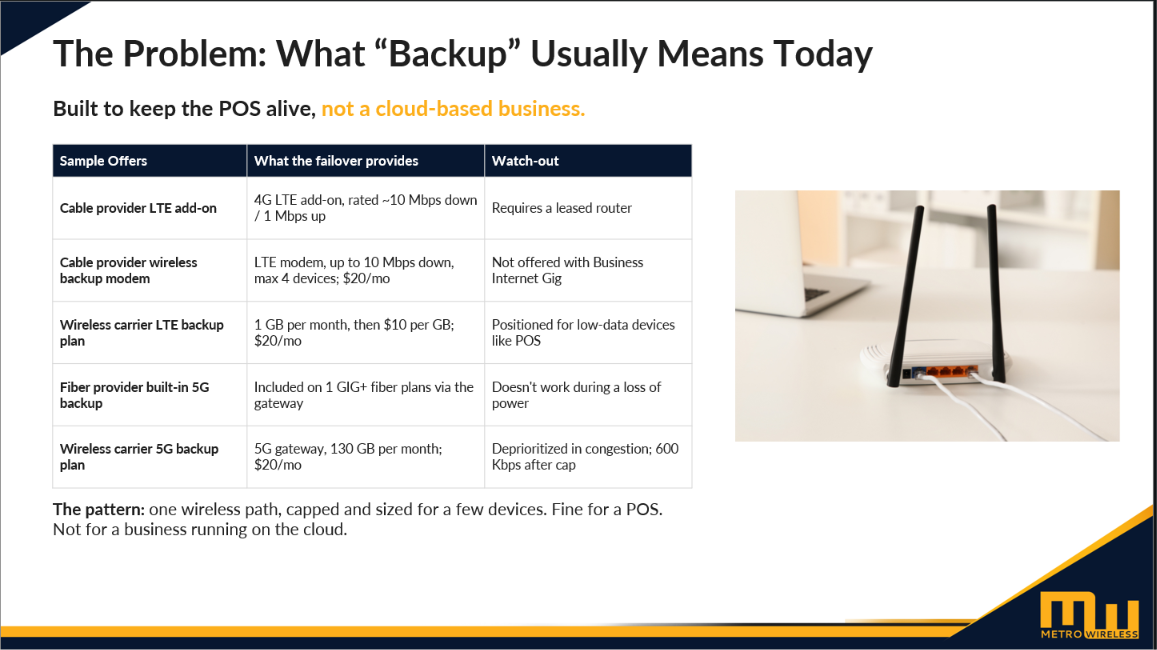
So what options are available to you? You can get a cable provider LTE add-on. Those are archaic. Comcast used to offer this, and Spectrum too. It was 4G, limited to 10 meg down. I used to compete against this, and it wasn't adequate in 2018, and it's preposterous now. That's the absolute bottom of the food chain. You may all remember this: the $30 Comcast add-on, remember that one? It was crap. It just made people feel better.
Okay? It made people feel better. A cable provider wireless backup modem is kind of the same thing. A wireless provider with LTE: again, that's 4G, so that's just not fast enough. A fiber provider with built-in backup: okay, maybe. Maybe it's the same carrier, maybe they have expertise in 5G, maybe they don't.
There are a lot of plans out there. When I was at Broadsky, I sold thousands of these: 4G backup at every location. It was a great solution in 2017. It's not 2017. We've upgraded our computers, we've upgraded our wardrobe, we probably have a new car, but we still have a 4G LTE circuit and we call it "we've got backup." I'm going to say no, you don't.
And by the way, now we're 96% dependent on the cloud. When we installed this 10 years ago, we were 17% dependent on the cloud. So you can see the pickle we've gotten into. We need to upgrade the contingency circuits across the channel, and we all have the opportunity to do that. So yeah, next slide, please.
[19:34] Tom Benson: So how big does it need to be?

[19:35] Stacy Conrad: This was my joke slide. All right.
[19:36] Tom Benson: This is your joke slide.
[19:39] Stacy Conrad: This was my joke slide. If you guys were around when this movie came out, then you've been doing telco for a while. Tom and I were talking about how we remember we used to size voice. You'd be selling a toll-free number, and the customer would say, "Well, how many minutes are we using?" How many calls do you expect? What's the peak time of the day? When do you run a sale? What happens if you get a busy signal? It was all those questions we asked back then about how you size voice.
What's interesting is a lot of thought went into it. There were spreadsheets and calculators and equations, and we really sized to make sure that our larger customers never received a busy signal. Now that we're talking about internet, it's a little different, but in a way it's really not.
What Tom and I have really been discussing is that the same exercise needs to go into not just buying for your customer what's available, but sizing what your customer needs. It really is a different way to look at it. Ideally, our goal is always to make our partners look good. So now we'll get into a little bit of how you size this, so that you show the value to your client and, more importantly, if your client needs it, they have the proper continuity solution. So if we go to the next slide.
[21:07] Tom Benson: I like my Breakfast Club, by the way. So we're going to get into the actual math versus the vibes. Before I get into that, though, I saw one question, and I don't think we touched on this enough. Housekeeping-wise, please ask your questions in the chat or the Q&A. We're not trying to do death by PowerPoint here. Sometimes the most valuable part of a webinar is the questions that come back. We think we're being super clear, and then the questions come back and we discover we weren't as clear as we thought.
So please ask your questions in the chat or the Q&A. The way we roll is we read the question for the benefit of everyone, then we answer it, and we all get smarter. We're going to send a copy of this out to everybody when we're done, so all the Q&A will be in there. That's my favorite part of webinars, actually, so fire away.
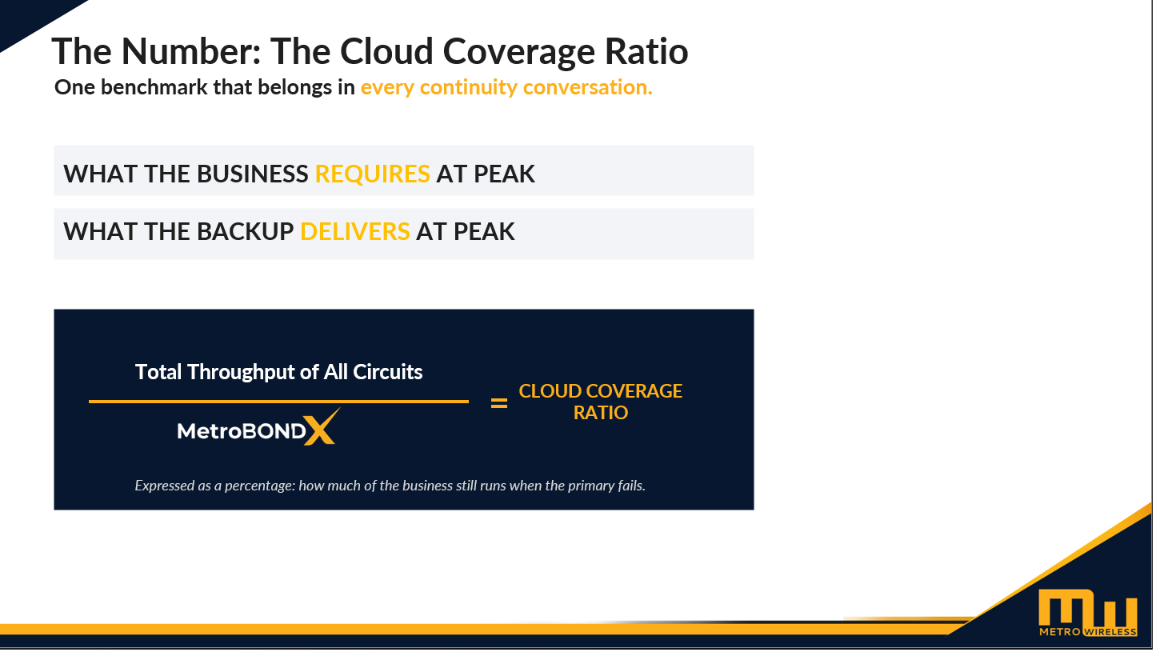
[21:59] Tom Benson: Okay, what is the Cloud Coverage Ratio? Well, it's really exciting if you're a wireless nerd. Speaking to what Stacy was speaking to: objectively, we would measure when your peak call period was. It was usually 11 o'clock on a Tuesday, when you had the most active circuits coming in. Say our peak is 79 simultaneous phone calls on Tuesday at 11 o'clock. Then we have to make sure you have 79 call paths available. Let's engineer that up by 10 to make sure; we'll go to 90, or something along those lines. We would have those conversations. We didn't talk about what we could just barely limp along with. We talked about what you need at peak to run your business.
That same sensibility applies to this. If you look at the total throughput of all your circuits and you divide it by MetroBOND X, which is our unbreakable wireless circuit that you cannot cut and you cannot flood, with the entire infrastructure of the wireless industry behind that statement, including sending calls to space through Starlink. That equals your coverage ratio.
So what's an acceptable coverage ratio? Again, making the point: your primary total throughput is there for a reason. People do not pay for throughput they don't need, within reason. You don't have a 10 gig circuit if you need 100 meg. So let's assume the primary fiber is there for a reason, and get into it a little further. Next slide, please.
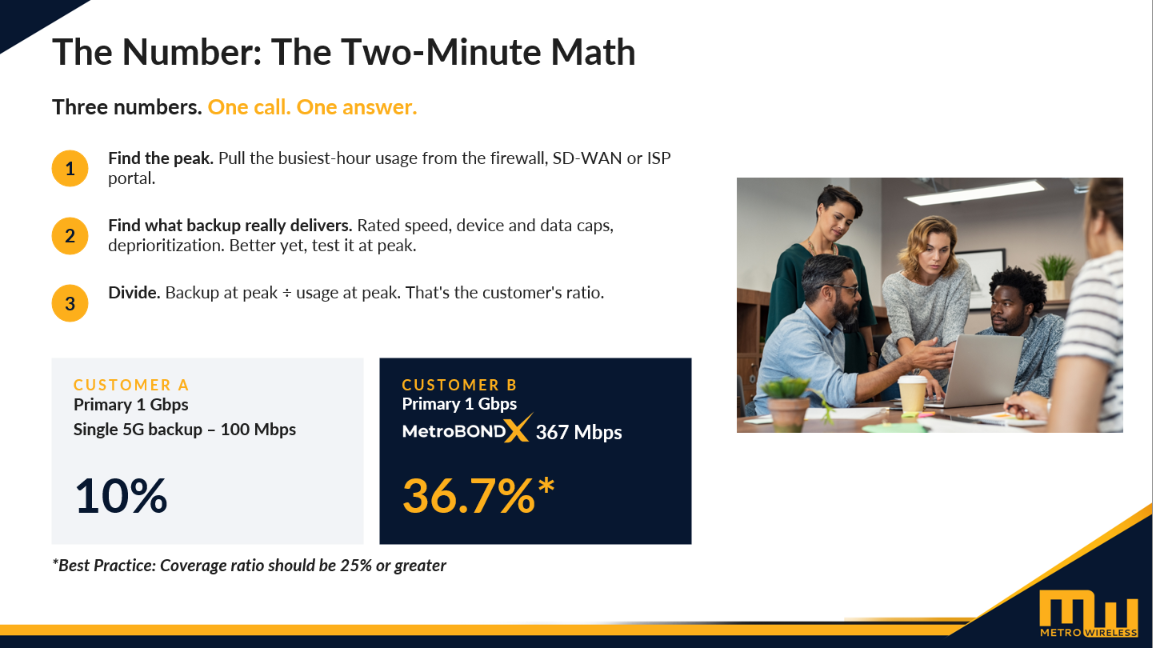
[23:28] Tom Benson: So there we go. Find the peak. We can use total throughput, which is a nice proxy: I have two 1 gig circuits, so I've got 2 gig. Okay, you have it for a reason. Then what is your peak at the moment? This is good information for any CIO. What's the peak usage you've ever had? Is it 800 meg? 600 meg? 250? And is it climbing? What's your trend line? What was it in January? What was it in December? In most cases, it's going up.
And finally, if you were to lose your primary fiber circuits, both of them, what do you have left? For a lot of customers, it's zero. "I have nothing beyond dual fiber feeds." So then the question is: Mr. Customer, do you realize you could lose $75,000 an hour, even though you have dual fiber feeds, if they're in the same trench coming into your building? Or they're in the same right-of-way in the street, or they terminate at the same distribution center two miles up the road, or they run up the same riser to get to the seventh floor? Anywhere you have a single point of failure, that's the business risk.
Next point: given that we're going to lose X amount, we'd like to recommend a circuit that eliminates this risk. That becomes MetroBOND: an unbreakable wireless circuit that's fast enough to run the business.
To finish off this slide: if your primary is 1 gig and you have a 100 meg 5G backup circuit, you have a 10% coverage ratio. 90% of your performance disappears and 10% is left, leading us back to the question: Mr. CIO, what applications would you like to turn off?
Or: Mr. Customer, I can get you an unbreakable wireless circuit here, binding multiple circuits together. That's what MetroBOND is, including Starlink, and 5G from T-Mobile, AT&T and Verizon in combination. We can get 367 meg. That's a very specific number, but it's our average across numerous deployments combining two circuits. That gives you a coverage ratio of 36.7%, and you can go back in and do the math and say, "Can we run 100% of our applications, even if we lose our fiber?"
Then you would ask the customer: who would you rather be? Would you like to turn things off, or would you like to keep things running? Their inevitable response is, "What does it cost me to keep things running?" Great question. We can put MetroBOND on top for your customer and give them unbreakable connectivity for less than $10,000 a year. For $10,000 a year, you can turn every facility into a bulletproof, unbreakable, no-loss-of-comms facility. In this day and age, guys, $10,000 just isn't that much money.
Said another way, a CIO may not say yes, but they're certainly not going to be affronted. They're not going to be offended that you offered them the concept: for $10,000, I can make sure you never lose internet at your precious facility. He could say no. She could say no. But they'll understand that you're looking out for their business and getting ahead of the curve, not just responding to their needs.
This is risk management. This is business continuity. This is a "how big is your insurance policy" type discussion. It's a CFO-type discussion. IT people maybe don't think about this, but CFOs think about it every day. It could be a new avenue to talk to people in the organization you currently don't have contact with, and get out of the IT side.
[27:17] Stacy Conrad: And I'll say, sorry, Tom, I know you and I have had some of these conversations. Having come from an MSP the past eight years, we included backup in every order we sold, or attempted to. I do think a lot of our partners have sold backup, and I think a lot of customers feel they have backup.
But the real test is that it was always "what backup is available for the least expensive price," versus "what backup covers my business now for the least expensive price." That's really where this conversation has changed. A lot of folks have checked the box. But what's moved to the cloud in just the past few years is so much more significant that just having backup isn't quite as good as it used to be. That's one of the great things about our industry: it's always changing. But it really does change that conversation, and makes you more credible when you point out the differences.
[28:28] Tom Benson: A decent analogy: housing prices have gone up quite a bit in certain areas of the country. You might have bought your house for half a million dollars and have a half-million-dollar home insurance policy. Now your house is worth $2 million. It's a nice problem to have, but if you still have a $500,000 policy, you don't have to upgrade it. It might cost more. You pay more every single month to have a $2 million policy, and you could choose not to. Very few people choose not to.
So there are a lot of different angles to come at this from, but at the end of the day, this is a risk management conversation. And I'll throw in: if we put MetroBOND in, not only are we protecting the business, but you can use that bandwidth every day. This is incremental bandwidth. You get something for your money. So it's kind of the best of both worlds: add speed and add protection. Yeah, next slide.
[29:22] Stacy Conrad: Yeah. This next slide hits a little more on MetroBOND, to make sure. We might have some folks here who haven't sold MetroBOND before.
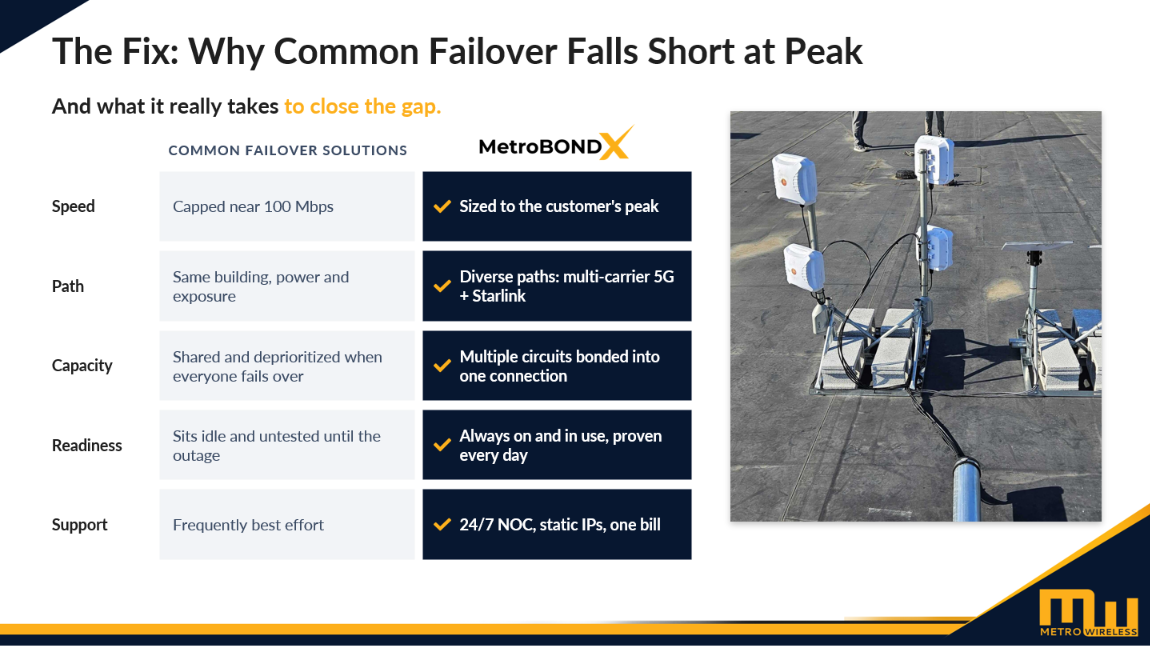
[29:28] Tom Benson: So, MetroBOND. We talk about this a lot, but we're just one organization, so we have to keep talking about it. MetroBOND is circuit aggregation for wireless circuits, combining the three 5G networks and Starlink. There is no actual limit to how many, but as a practical matter, once you get past 20 bonded circuits, the cost gets pretty out of hand. There are numerous 20-circuit bonded devices out there on cruise ships, actually. Twenty is kind of the number they settled on; they have 20 Starlinks sitting up there.
What you're looking at is the rooftop installation for what we would call a MetroBOND X6. There are six separate circuits here. You're looking at four different external antennas pointing to towers, and I happen to know this deal. Two of those are pointed at T-Mobile and two are pointed at AT&T. You can see the external antennas on the left there are pointing in different directions. So we have two circuits to T-Mobile and two to AT&T. Then you see two Starlinks next to it: one is in clear view, and you just see the edge of the other one. That's the head end, if you will, where we're getting connectivity from three separate networks.
Then we drop it down into the control room, where there's a piece of technology from Peplink called SpeedFusion, which is what we built MetroBOND on top of. That aggregates all six of those circuits into one usable download and upload circuit. And just for fun, we put five static IPs on this, and there's BGP routing with their fiber circuit. So this is enterprise grade. This is not Joe's Bait Shop. This is the headquarters of a federal credit union in Louisville, whose CIO dictated that we will not have downtime. Ever.
The circuit is $2,700 a month, just to put things in perspective. They got 860 down and 240 up, with five static IPs and latency under 90 milliseconds. And they're planning on installing a second one at their data center in Q1 2027.
[31:40] Stacy Conrad: Love it.
[31:41] Tom Benson: And they have 27 more branches. This is a classic land-and-expand opportunity. We have another customer down in Texas who wanted exactly this product, Starlink plus 5G, because they experienced the ice storms four years ago. They lost power, all the cellular networks died, but Starlink kept on running, so they wanted the best of both worlds.
We're starting to hear this from a number of people: "I will not have downtime, ever. Make that happen." And they're finding us. So it's a great chance to get ahead of the curve. That's MetroBOND. Hopefully I've answered the question "What is MetroBOND?" That's MetroBOND and how we use it.
[32:21] Stacy Conrad: And I think the next slide does one more cool example.
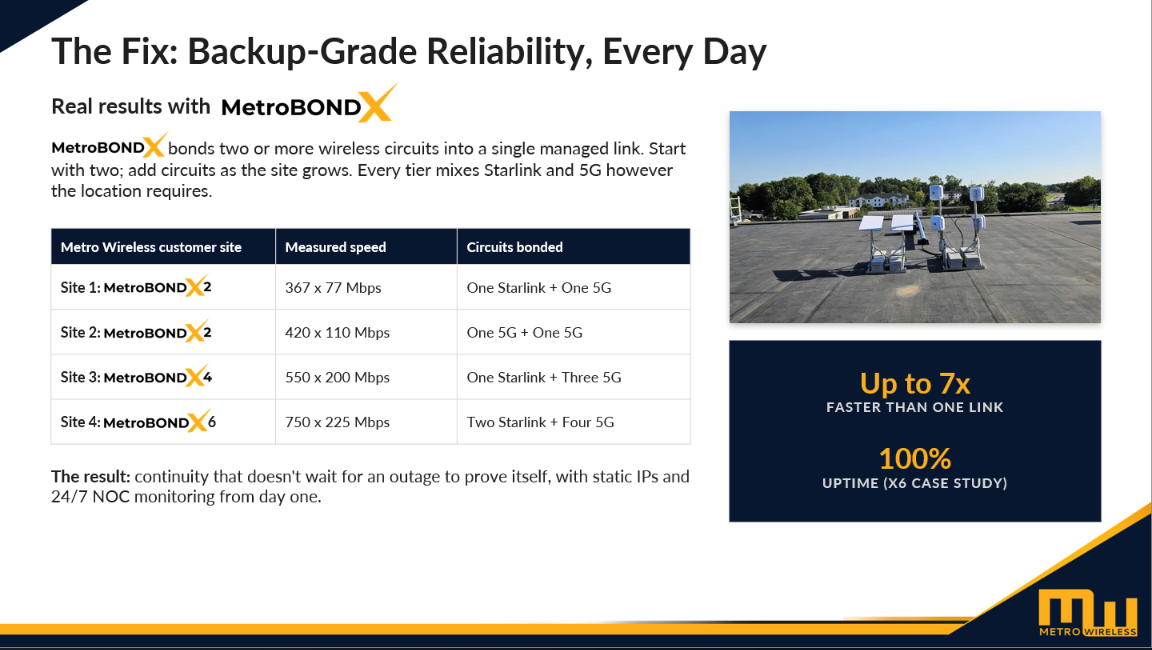
[32:25] Tom Benson: Yes. So this is more examples. We showed you one, the X6, and these are ones we've deployed around the country.
One of the things I want to point out is that we've gone through the learning curve, because you're starting to hear about bonding from other providers. T-Mobile's talking about bonding with their SuperBroadband product, but it's not bonding, which is fun to explain against. It's not even load balancing. It's just two wireless circuits, and you use one or the other: active, inactive, back and forth. We call that version 1.0. We started doing that four years ago.
Bonding is hard. There was a big learning curve, and we've gone through it. If you haven't gone through it, you're still making mistakes. If you bond two circuits together and you don't know what you're doing, you can actually make it slower. Just so you know the downside: if you don't match them up properly, you take a 100 meg circuit and end up with 55 meg, because of packet contention and a lot of other things I won't get into.
We're easily in the hundreds of deployments. I don't know how far into the hundreds, but every time we deploy one, we get smarter. So we're separating ourselves from the pack. I'm noticing people just getting into this and talking about it, so I'm kind of excited, because T-Mobile is going to raise awareness of this and then we're here to deliver. This is not easy to do, and I guess I'll leave it at that. So around the country, we've got... yeah, go ahead, Stacy.
[34:00] Stacy Conrad: Oh, I just have one comment, because I think what's really unique about MetroBOND, when a lot of people look at this slide, is the mix and match. Tom highlighted this a little bit. This can be two 5G, four 5G, three 5G and a Starlink, two Starlinks. The combinations depend on the customer's requirements: their upload and download speeds, their cost budget, and their location.
What's really nice is this isn't just an off-the-shelf "sell me a MetroBOND." We ask a few questions each time, and it helps us put together exactly the unbreakable MetroBOND solution your client needs. I think the guys told me there are something like a thousand combinations by the time you put it all together. But what's nice is, for each customer, we truly qualify and find the right solution that fits their location, their budget and their speed requirements.
[35:03] Tom Benson: The rate grid gets silly. You can go out to eight, and you can have eight 5Gs, or eight Starlinks, or any combination in between. For the math nerds out there, it's 8 to the something power, and it gets out of hand. Then you throw in term lengths and different data plan sizes, and it's completely out of hand. So we don't want to get granular and eye-glazing. We want to stay a little more conceptual.
The opportunity here: wireless internet is traditionally associated with delivering internet to hard-to-reach places, or to mobile assets. We're still in both of those businesses. What we'd like to add to the mix is your premier suburban location, with seven different fiber providers. They have a need for wireless internet, not for connectivity, but because of the cloud.
Three nines is enough without the cloud. Once you add the cloud, three nines is not enough, and neither is four nines. You're still looking at hours of downtime per year, and that's too expensive now. So we can help fill that gap. Or, on the front end of the curve, on your cloud initiatives or whatever initiative you have running, if you add us to the mix as a value add, you will separate yourself from all the other people bidding the same thing. Say, "We recommend this because of the value of that."
Wireless isn't a cute tack-on anymore. It's now becoming integral to ongoing communications because of the cloud, because of AI, because of IoT. If there's any message we're trying to get across today, it's that.
[36:45] Stacy Conrad: Okay. All right, let's see, next.
[36:49] Tom Benson: So, go ahead, Stacy.
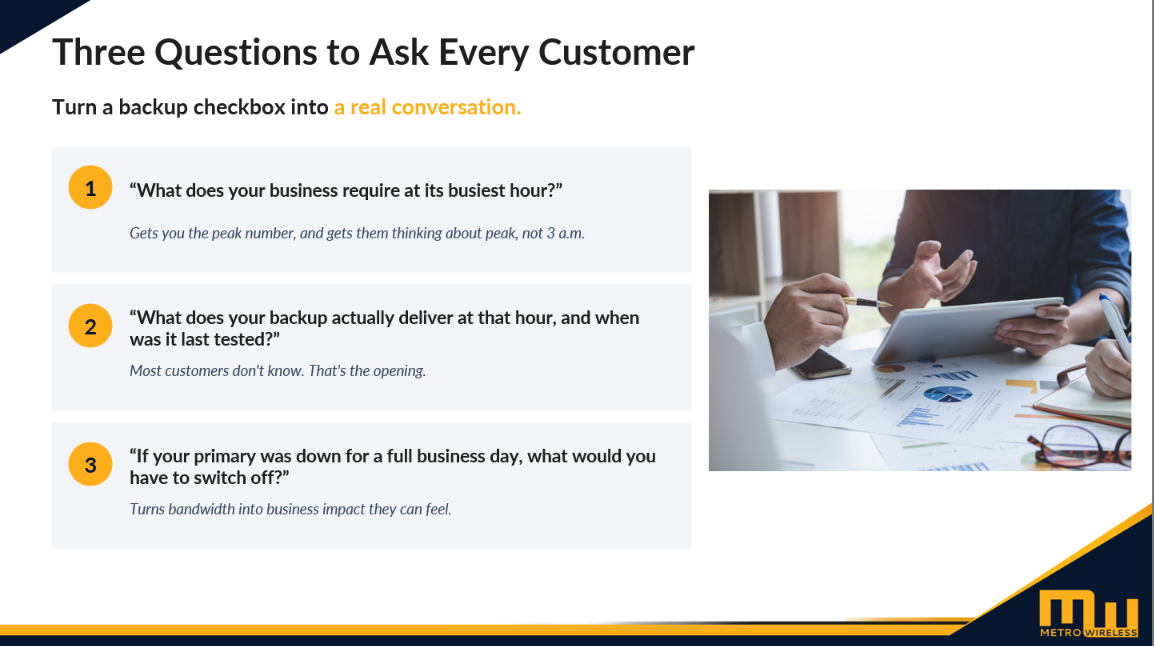
[36:50] Stacy Conrad: All right. As you guys are working with your customers, take everything we've covered into a really simple conversation. First: what does your business require at its busiest hour? Whether they're using a firewall or SD-WAN, they have this type of information. Let's figure out what they truly require, so you know what the peak number looks like.
Second: what does your backup deliver at that hour, and when was it last tested? It's a great conversation. They might know quickly what their backup speeds are. "When was it last tested?" might be a whole other conversation, and hopefully a great door opener for you.
And finally: if your primary was down for a full day, what would you have to switch off? Sometimes it's hard to say how much it would cost you. A lot of customers know that, but your contact doesn't always. So what would you have to switch off? People could say, "We can do without email," or "Maybe we can do without phones." It depends what type of business it is. They're going to have to choose. And if they really can't do without anything, then we need to size backup a little bit differently.
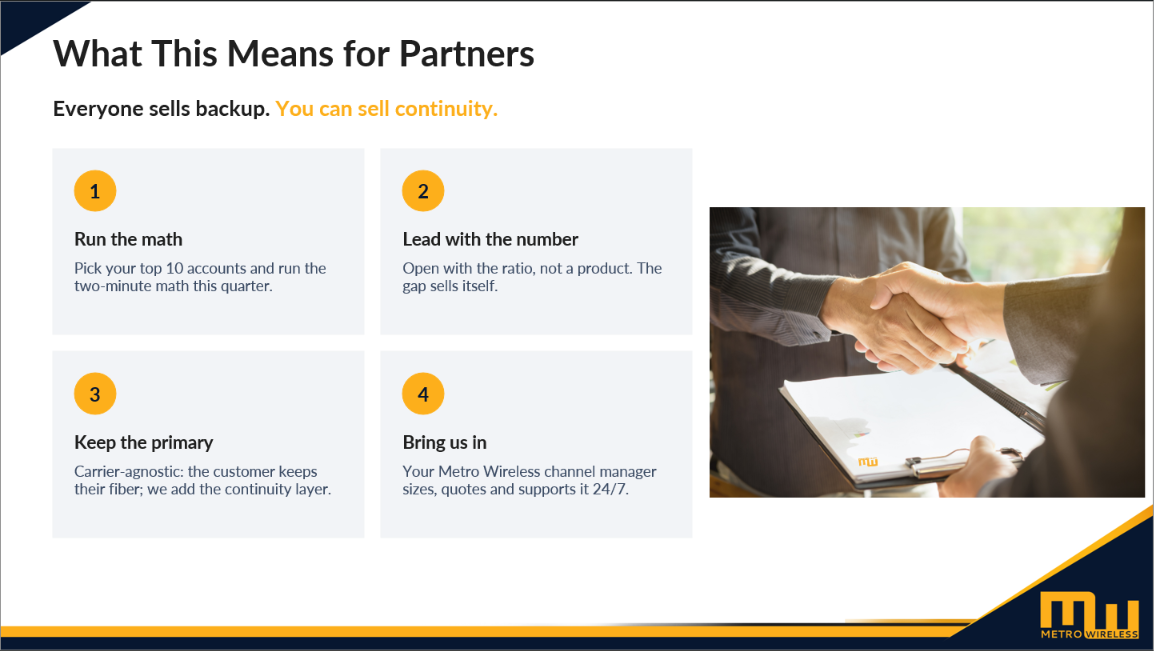
[38:04] Stacy Conrad: So if we go to what I believe is the last slide: what does this mean for you guys? All of you already sell backup. I don't think I could find a partner that hasn't sold any backup. We really want to help you sell continuity. We want to help you talk about the math, leading with that number and talking about the ratio.
Fiber's great; we all need it. We're not trying to diss it in any way. We want to talk about how we work with it, and how you can bring us in. We can help you quote it, help you support it, and make sure you have a good outcome. Our goal is just to help you. You've had some of these conversations already. We want to make them make more sense, and give good, secure suggestions to your customers. That's what we're looking to do.
[38:56] Stacy Conrad: So let's open up for some questions. I believe the last slide says, "Hey, do you have questions?" It does. As a reminder, before we answer some of the questions while Tom's looking at the box: if you do have opportunities, you can email any of us directly, but if you send your request to sales@metrowireless.com, it automatically opens a case in Salesforce. It triggers our team and allows us to get qualifying questions or details from you, so we can respond to you faster, because that is our goal.
And of course, we have resources available to get on calls to help with discovery for any of our products and solutions. But very specifically today, we're focusing on backup and continuity. What have we got for questions, Tom?
[39:43] Tom Benson: So here's what I'm going to do. I'm in the chat, and I'm going to go down the chat questions first, and then I'll move over to Q&A.
[39:51] Stacy Conrad: Oh, okay, yep, same thing. Either way, I know people do chat or Q&A; they can hit either button.
[39:54] Tom Benson: Yep, either way. But once I leave chat, I'm not coming back. So if you have a new question, please put it in the Q&A, otherwise I might miss it.
Okay, so, Ron from Sarasota, who's apparently floating out to sea along with Stacy...
[40:08] Stacy Conrad: Oh, he's floating too, yep!
[40:09] Tom Benson: Yep, yep. He wrote: "My auto dealership client with 200 employees had their 1 gig fiber circuit drop, failed over to 5G cellular, and they couldn't run their business. What would you recommend?" Two hundred employees: just think about the payroll every day, and then assume they're profitable. Think about the revenue every day to pay for that payroll.
[40:34] Stacy Conrad: Did you plant this, or is Ron really there? Because, Ron, thank you. Love it.
[40:40] Tom Benson: Ron from Sarasota, are you actually Stacy from near Orlando?
[40:41] Stacy Conrad: Yeah, that's a perfect question, Ron, so thank you.
[40:45] Tom Benson: Thank you, Ron. That's an excellent example of a real-world pain point, and I would imagine the dealership was not happy. If they start looking for people to blame, they'll start with the person who recommended a single 1 gig fiber circuit for their multimillion-dollar business.
What we would recommend in that situation: if it's a 1 gig circuit, let's assume they need at least 400 meg to run the business. We would engineer, test out and prove a 400 meg circuit for them, using as many wireless circuits as we need to get to 400. I wouldn't say, "This is how many circuits you need." I would say, "This is how much speed you need, and here's what it's going to take to get there."
The variable with wireless is the 5G networks. I know what Starlink is going to do: it's going to deliver about 175 down and 15 up. If I'm wrong, I'm not wrong by much. It might be 160, it might be 190, but it's not 400 and it's not 30. Starlink's pretty predictable. 5G is not. Some 5G is screaming fast, 600 meg down on a single circuit at 7 o'clock at night. But a month later it's dropped to 400, and a month after that it's dropped to 200, because carriers add capacity, it gets gobbled up, they add capacity, it gets gobbled up. It's a never-ending game. 5G, generally speaking, will deliver about 150 down, but the range is insane.
The other problem with 5G is where am I going to get that signal? I might have 300 meg on the roof, but 80 meg inside the IDF closet, the computer closet, because of all the interference. That's where we start engineering solutions. Again, I'm getting granular.
What I would recommend is getting agreement with the end user: what's your minimum bandwidth speed? And would you be willing to pay within X budget range to get there? If I can deliver that minimum within that budget range, will you buy the product? Hopefully we get agreement, they say yes, we install it, and we prove it. That's what we did at the credit union. We had to deliver 700 meg down, we did, that triggered the clause, and away we went. They were skeptical you could deliver that much constant speed, and we could.
So, Ron, I would go through that exercise with this dealership. Now that they've had a disaster, they're probably open to it. Go from there. That's my answer.
[43:24] Tom Benson: I have more of a comment than a question from Marino, but it's a good one: "I find it expensive. $800 MRC for 347 meg broadband speed." I agree with you. It is expensive. You could get a fiber circuit for a lot less than that. What's not expensive about it is when you add the element that you cannot cut it. You cannot cut it, and there's no other option that can say that.
The context we're in is not delivering gigs per dollar. We fully understand that fiber is cheaper per gig. The laws of physics dictate that, and there's no arguing with Einstein. What we're arguing for, Marino, is that because of those cheap gigs, people rely on those cheap gigs. They run their entire business on those cheap gigs, and if the cheap gigs go away, it hurts. So we are not the cheapest cost per gig. We never claim to be and we never will. We're the one you can't cut. Fiber can't say it, broadband can't say it, dual fiber feeds can't say it, and we can. That's the thrust of what we're trying to get across.
[44:33] Stacy Conrad: And I will add, Tom, because I think that's a really good point: you used the example of the price of the MetroBOND X6, but we have customers with a MetroBOND X2 for, say, $500 a month. So just to give some perspective, the example Tom gave needed greater speeds, and that was the fit for them. It does range. It depends what we're bonding together, so the price goes up or down. There isn't a fixed cost; we work it backwards based on what's available and how much speed they need.
[45:09] Tom Benson: The price range on this is $600 to $2,500 a month, just for context, so you understand what we're dealing with. It's not $100,000 a month, and it's not $50 a month. And we're delivering real speeds, and we keep getting faster. A year from now, we'll probably be at the same cost and 50% faster, because that's just the nature of things. But the demand will be 50% higher, so the essential problem is never going to change.
Okay, that's the Q&A. Now if I go to chat and see if anyone's in chat... nobody is in chat.
[45:48] Stacy Conrad: Okay. Let's see, everyone followed the instructions to enter Q&A instead of chat.
[45:52] Tom Benson: Yes, they did. Yes, they did. Okay, I got another question in: "Do you have to put the Starlink and the 5G antennas on the roof? And if so, who does it?" So it's a two-part question.
The answer to your first question, does the Starlink have to go on the roof: yes. Starlink has to be on the roof. It has to see the sky. Starlink signals do not penetrate buildings, period, because they're coming from space. So you have to put that dish up on the roof to make sure there are no physical materials blocking your signal. Drywall will block a Starlink signal.
5G is different. 5G does penetrate buildings. Your phone works inside, and you can go on Facebook inside your house. Facebook, dating myself. The wrinkle is 5G doesn't work as well inside. There are 5G frequencies that are higher and narrower. They're the fastest frequencies being broadcast, and they don't penetrate buildings as well.
So the more nuanced answer is 5G works faster if you put an antenna on the roof. We will make all those arrangements. We know which antenna to use, we know where the tower is, and we know where to point it. We'll take care of everything, and it will run faster, but it is not required.
I don't have the right answer to this, but we know how to ask the right question: is it worth it to spend about $1,500 up front to put an antenna up, and in exchange, your wireless circuit runs 50 to 80% faster for the rest of its life? That is the question. I do not have the answer. The end user can make that determination. But it's a good question; it helps crystallize it.
[47:49] Stacy Conrad: But do talk, Tom, about self-install versus professional install as well.
[47:54] Tom Benson: So if we just ship out a router, a simple 5G service, that's a self-install product, and it takes five minutes. A third grader could do it, let's say. They put it in their control room, screw in four antennas, plug it into the wall, run Ethernet from our port to their switch, boom. They've got 5G backup. That business has been around for a long time. It's still simple, and it's maybe arguably sunsetting. I don't have the right answer here, but one single modem is fine for a convenience store. For anything of value, in the advent of the cloud and AI, I'm just not sure it's fast enough anymore. DSL was a thing until it wasn't, and I'm wondering if single-circuit 5G is becoming DSL, quite honestly, if we're going to level up.
[48:56] Stacy Conrad: But answer the question about the installer. Let them know.
[49:01] Tom Benson: Go ahead, ask it again.
[49:01] Stacy Conrad: Well, you said self-install versus... Our professional install includes it, just so they know that we will do the full install.
[49:06] Tom Benson: Yeah. If we go to pro install and put an antenna up, we're going to send someone by to put an antenna on the roof, and we're going to get those speed gains, and they'll take care of everything. We'll mount the small antenna; it's not even the size of a dinner plate, more like half a dinner plate. When you go to those really cheap all-you-can-eat buffets and they give you the little tiny plate so you can't load up, that's how big it is. Then they run a wire down, plug it into our router, and we'll take care of installing the router and interconnecting it to the customer's designated WAN port.
The only thing we need in that regard is a strong local project manager, a strong local contact. Someone we can call and say, "We'll be there at this time. Make sure you open the door. Make sure I can get on the roof." Just the typical things, and navigating building security. But other than that, we'll take care of everything.
[50:02] Stacy Conrad: Perfect. Well, good! Those were some great questions. Thank you, guys. We always appreciate everyone's time. We know you're very busy, and we appreciate you giving us almost an hour out of your day. If we don't talk to you before next week, wishing everybody a wonderful Thanksgiving holiday. We look forward to your business and to partnering with you. So thank you. Thanks, Tom. Have a good day, everybody.
[50:28] Tom Benson: Thanks, everyone. Bye.
[50:31] Stacy Conrad: Bye-bye.


